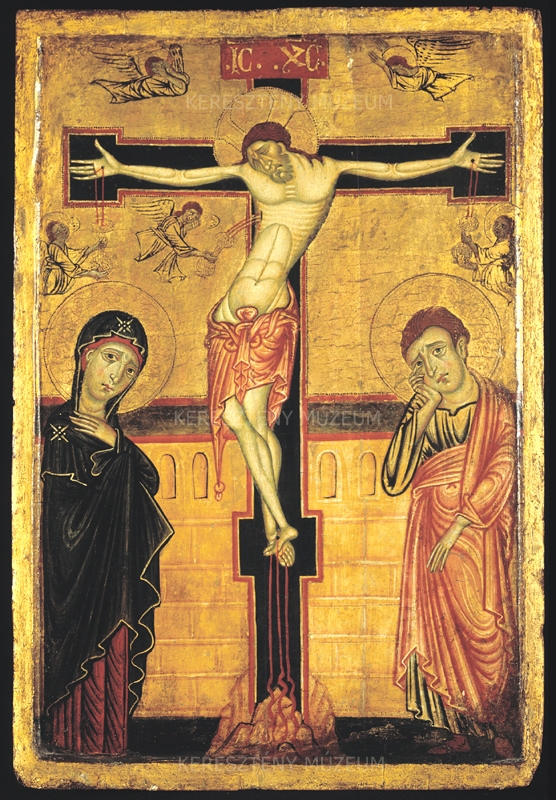
Crucifixion
ca. 1280 (?)
tempera and gold on wood
43 x 29.5 cm
Inv. 55.133
The oldest painting conserved in the Christian Museum shows the stylistic features of the Italo-Byzantine style dominant in 13th-century Italy: it is characterized by symmetrically arranged, schematized forms, sharp contours and strong highlights. The representation of the Saviour hanging on a blue-coloured cross recalls the painted crosses (croci dipinte) widely spread in this period. The two mourning angels hovering above bury their faces in their hands; three others below collect the redeeming blood of the Savior that breaks forth from the holy wounds. Christ’s elongated body forms a contrast with the squatter figures of the Virgin and St. John the Evangelist. The latter’s expressive gaze directed on the viewer calls for compassion. The work, which researchers believe to have been the right wing of a diptych, was made in the Florentine workshop of the Magdalene Master. The master, who received his conventional name after an altarpiece in the Galleria dell’Accademia in Florence, is one of the important and much discussed figures of 13th-century Florentine painting. According to some scholars his output, heterogeneous and open to novelties, is in fact attributable to more than one artist or to a workshop.
D.S.