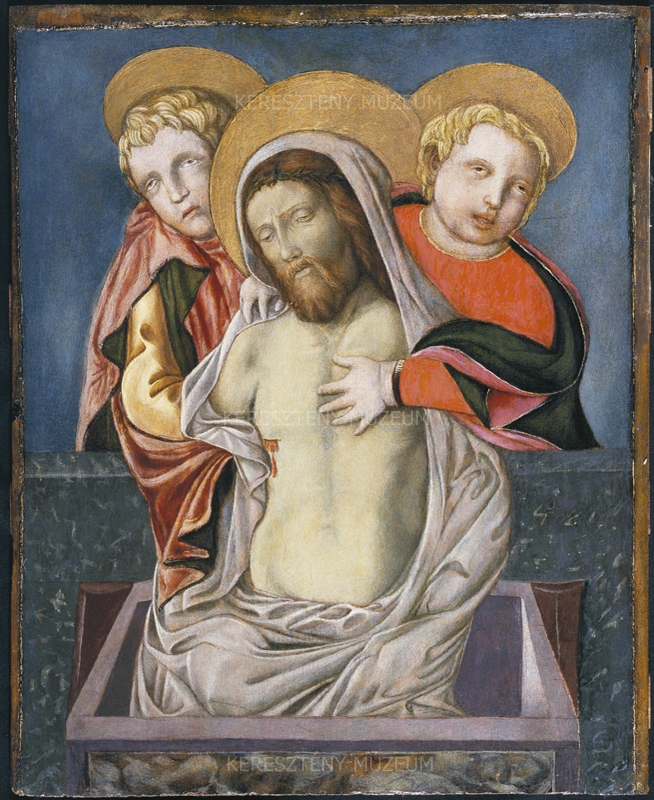
Dead Christ with Two Angels
1433 (?)
tempera and gold on wood
painted surface: 42.2 x 33.1 cm
Inv. 55.240
The veneration of the Eucharist and the various Eucharistic cults flourished in the 14th and 15th centuries. Consequently, the so-called Pietà-image showing the dead Christ as a sacrifice became frequent in Italian art. In the various depictions, the helpless body of the Saviour is supported by accompanying figures: usually the Virgin and Saint John the Evangelist, Joseph of Arimathea and Nicodemus, or – as here – two angels appear in this role. With faces distorted by sorrow, the angels hold up and at the same time present to the viewer the body. It is wrapped in a masterfully painted shroud and placed in a marble sarcophagus shown in foreshortening in front of a marble parapet. By drawing a parallel between the body and the Eucharist, this emotionally filled representation invites the viewer to meditate on the sacrifice of Christ. The origin of the picture was uncertain for a long time; it was believed to be a Venetian, Veronese or Paduan work. Only recently, in 1996 was the name of great Florentine artist, Filippo Lippi raised. According to Andrea de Marchi’s well-founded hypothesis, the work was executed during Lippi’s stay in Padua, in 1433. It was perhaps the central part of a triptych, flanked by wings representing the mourning Virgin and Saint John the Evangelist. The style is certainly related to Lippi’s early works; the condition of the picture, however, makes judging authorship difficult.
D.S.