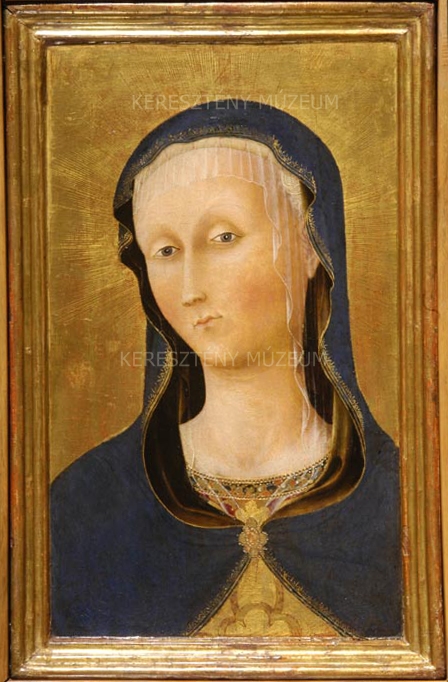
Portrait of the Virgin
1440s
tempera and gold on wood
47.5 x 29.9 cm (with original frame)
Inv. 55.186
Pietro di Giovanni d’Ambrogio worked in the first half of the quattrocento in Siena under the influence of the greatest master of the time, Sassetta. The Christian Museum owns two of the few works known by him. In this work showing the Virgin, neither the Child nor Mary’s hands are visible. For this reason, it was for long believed to be the fragment of a larger work. By now it has become certain that the present form of the work is original and that it is a rare representation that has only one analogy in early Italian painting (circle of Lorenzo Monaco, Amsterdam, Rijksmuseum). These paintings are probably best interpreted as “authentic portraits of the Virgin”, and are closely linked to the venerated images of the Madonna which tradition believes St. Luke himself painted. The reverse of the panel is covered with painting imitating a porphyry disk enclosed in a green frame. Porphyry, a purple-coloured stone, was a symbol of sovereignty in Antiquity and in the Middle Ages. It is probably to these royal associations that the decoration of the reverse refers. The fact that the panel is painted on both sides indicates that it was portable, perhaps used in processions.
D.S.