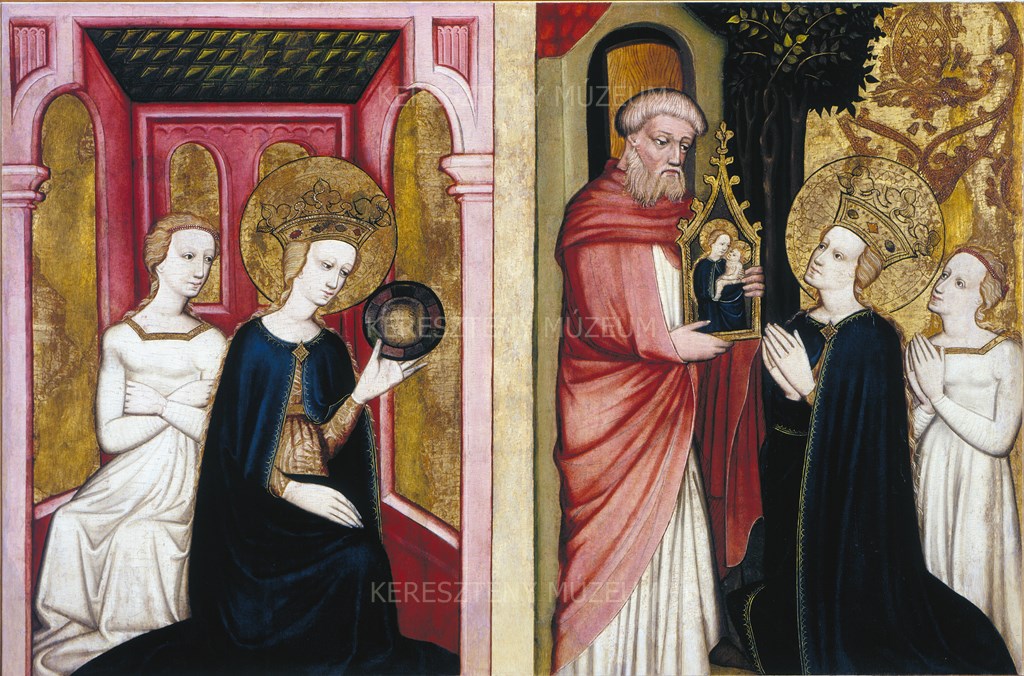
Two scenes from the legend of St. Catherine of Alexandria; detail from the movable wing of a winged altarpiece.
c. 1430
Pine, tempera
Inv. 54.2.1
St. Catherine observing herself in the mirror, searching for her betrothed The conversion of St. Catherine: a hermit showing St. Catherine the only bridegroom worthy of her
88 x 130 cm
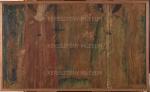
Originally painted on both sides, this panel painting certainly adorned the movable wing of an impressive winged altarpiece consisting of eight or twelve scenes from the life of St. Catherine of Alexandria. The scene on the former feast-day side of the panel is in relatively good condition, although it bears traces of multiple efforts at restoring and adding to the work. However, the depiction on the workday side, painted directly on the wood without any grounding, is strongly abraded. The trimming of the verso may have occurred when the two images were sawed apart (1969); this would explain the difference in the dimensions of the two works. Presumably the altar wing had been trimmed all the way around beforehand; the original dimensions may have been 120 x 140 cm.
In Bát, the two Catherine panels were placed in the same frame along with two other paintings of female saints dated to c. 1480 (55.44; 55.45). Together the works served a new secondary function as an antependium.
Provenance:
According to the authors of the Christian Museum’s 1964 catalogue, the panel originally belonged to a winged altarpiece from the Benedictine Abbey of Garamszentbenedek (?) or the Church of St. Catherine in Selmecbánya (?) The panel was purchased by János Csernoch, archbishop of Esztergom, from the Church of St. Martin in Bát for the Christian Museum in 1916.
Restoration:
Sebestyén Endrődi, 1916; Dezső Varga, 1955-56; Dezső Varga, 1969 (sawing apart, new base).
Bibliography:
Henszlmann Imre: Utijegyzetek. In: Archeológiai Értesítő 12 (1878), 248. – Divald Kornél: Magyarország csúcsíves kori szárnyasoltárai. II., Bp. 1911, 22-26. – Gerevich Tibor: A régi magyar festészet a prímási képtárban. In: Az Újság 1916. júl. 14. 3. – Gerevich 1916, 553. – Gerevich Tibor: A régi magyar művészet európai helyzete. Budapest, 1924, 14. – Lepold-Homor 1924, 96. – Gerevich Tibor: Von den älteren ungarischen Kunst. In: Ungarische Jahrbücher 5 (1925), 155-156. – Genthon István: Magyar művészek Ausztriában a mohácsi vészig, Budapest, 1927, 56-57. – Gerevich-1928, 205-206. – Benesch-1929, 68. – Péter András: A magyar művészet története. I. Budapest, 1930, 100-102. – Ludwig Baldass: Nürnberger Tafelbilder aus dem zweiten Viertel des 15. Jahrhunderts: ein Nachwort zur Nürnberger Ausstellung von 1931. In: Städel Jahrbuch 7-8 (1932), 132, pict. Nr. 72/53 – Genthon-1932, 23-26, pict. Nr.2. – Hekler Antal: A magyar művészettörténet története. Bp. 1934, 60. – Pigler Andor: Hekler Antal - A magyar művészet története (recenzió). In: Magyar Művészet 11 (1935), 117. – Hekler Antal: Ungarische Kunstgeschichte. Berlin 1937, pict. Nr.76, 104. – Csánky Miklós: A szepesi és sárosi táblaképfestészet 1460.-ig. Bp. 1938, 5-6. – Guy de Tervarent: Les énigmes de l’art du moyen age, I. Paris 1938, I. 9-12. – Genthon-1948, 3-14. – Radocsay-1955a, 10. – Radocsay-1955b, 46-47; 275-277. – Entz Géza: ( book review). In: A Magyar Tudományos Akadémia Társadalmi-Történeti Tudományok Osztályának Közleményei 7 (1956), 360. – Mojzer-1958 Nr. 5. – Lajta Edit: Jaroslav Pesina: Tafelmalerei der Spätgotik und der Renaissance in Böhmen (recenzió). In: Művészettörténeti Értesítő 8 (1959), 170. – Mucsi András: A báti képek ikonográfiája. In: Annales Strigonienses I. Bp. 1960, 11-23. – Dercsényi Dezső: Annales Strigoniensis. – Esztergom Évlapjai. (recenzió) In: Művészettörténeti Értesítő 10 (1961), 243. – Stange, Alfred: Deutsche Malerei der Gotik, XI. München-Berlin 1961, 151-156. – Radocsay-1963, 39-40. – Boskovits-Mojzer-Mucsi-1964, 114-115. – Mucsi-1973, 9. – Mucsi-1975, 9. – Anton Legner (Hg.): Parler und der schöne Stil 1350 - 1400, I - IV., Köln 1978, II, 458-459 (A. Mucsi), III, 220, 228-229 (A. Legner). – Marosi Ernő (szerk.): Magyarországi művészet 1300-1470 körül. I., 1987, 212, 617, 711, 713, 714, 720, 733, 865. – Mucsi-1990, 4. – Cséfalvay-1993, 175 (Török Gy.). – Pannonhalma-2001, 174. – Pozsony-2003, 699-700. 4.21 (M. Bartlova). – Budapest-Luxembourg-2006 6, 7.63. (Poszler Gy.)
Originally painted on both sides, this panel painting certainly adorned the movable wing of an impressive winged altarpiece consisting of eight or twelve scenes from the life of St. Catherine of Alexandria. The scene on the former feast-day side of the panel is in relatively good condition, although it bears traces of multiple efforts at restoring and adding to the work. However, the depiction on the workday side, painted directly on the wood without any grounding, is strongly abraded. The trimming of the verso may have occurred when the two images were sawed apart (1969); this would explain the difference in the dimensions of the two works. Presumably the altar wing had been trimmed all the way around beforehand; the original dimensions may have been 120 x 140 cm.
In Bát, the two Catherine panels were placed in the same frame along with two other paintings of female saints dated to c. 1480 (55.44; 55.45). Together the works served a new secondary function as an antependium.
Provenance:
According to the authors of the Christian Museum’s 1964 catalogue, the panel originally belonged to a winged altarpiece from the Benedictine Abbey of Garamszentbenedek (?) or the Church of St. Catherine in Selmecbánya (?) The panel was purchased by János Csernoch, archbishop of Esztergom, from the Church of St. Martin in Bát for the Christian Museum in 1916.
Restoration:
Sebestyén Endrődi, 1916; Dezső Varga, 1955-56; Dezső Varga, 1969 (sawing apart, new base).
Bibliography:
Henszlmann Imre: Utijegyzetek. In: Archeológiai Értesítő 12 (1878), 248. – Divald Kornél: Magyarország csúcsíves kori szárnyasoltárai. II., Bp. 1911, 22-26. – Gerevich Tibor: A régi magyar festészet a prímási képtárban. In: Az Újság 1916. júl. 14. 3. – Gerevich 1916, 553. – Gerevich Tibor: A régi magyar művészet európai helyzete. Budapest, 1924, 14. – Lepold-Homor 1924, 96. – Gerevich Tibor: Von den älteren ungarischen Kunst. In: Ungarische Jahrbücher 5 (1925), 155-156. – Genthon István: Magyar művészek Ausztriában a mohácsi vészig, Budapest, 1927, 56-57. – Gerevich-1928, 205-206. – Benesch-1929, 68. – Péter András: A magyar művészet története. I. Budapest, 1930, 100-102. – Ludwig Baldass: Nürnberger Tafelbilder aus dem zweiten Viertel des 15. Jahrhunderts: ein Nachwort zur Nürnberger Ausstellung von 1931. In: Städel Jahrbuch 7-8 (1932), 132, pict. Nr. 72/53 – Genthon-1932, 23-26, pict. Nr.2. – Hekler Antal: A magyar művészettörténet története. Bp. 1934, 60. – Pigler Andor: Hekler Antal - A magyar művészet története (recenzió). In: Magyar Művészet 11 (1935), 117. – Hekler Antal: Ungarische Kunstgeschichte. Berlin 1937, pict. Nr.76, 104. – Csánky Miklós: A szepesi és sárosi táblaképfestészet 1460.-ig. Bp. 1938, 5-6. – Guy de Tervarent: Les énigmes de l’art du moyen age, I. Paris 1938, I. 9-12. – Genthon-1948, 3-14. – Radocsay-1955a, 10. – Radocsay-1955b, 46-47; 275-277. – Entz Géza: ( book review). In: A Magyar Tudományos Akadémia Társadalmi-Történeti Tudományok Osztályának Közleményei 7 (1956), 360. – Mojzer-1958 Nr. 5. – Lajta Edit: Jaroslav Pesina: Tafelmalerei der Spätgotik und der Renaissance in Böhmen (recenzió). In: Művészettörténeti Értesítő 8 (1959), 170. – Mucsi András: A báti képek ikonográfiája. In: Annales Strigonienses I. Bp. 1960, 11-23. – Dercsényi Dezső: Annales Strigoniensis. – Esztergom Évlapjai. (recenzió) In: Művészettörténeti Értesítő 10 (1961), 243. – Stange, Alfred: Deutsche Malerei der Gotik, XI. München-Berlin 1961, 151-156. – Radocsay-1963, 39-40. – Boskovits-Mojzer-Mucsi-1964, 114-115. – Mucsi-1973, 9. – Mucsi-1975, 9. – Anton Legner (Hg.): Parler und der schöne Stil 1350 - 1400, I - IV., Köln 1978, II, 458-459 (A. Mucsi), III, 220, 228-229 (A. Legner). – Marosi Ernő (szerk.): Magyarországi művészet 1300-1470 körül. I., 1987, 212, 617, 711, 713, 714, 720, 733, 865. – Mucsi-1990, 4. – Cséfalvay-1993, 175 (Török Gy.). – Pannonhalma-2001, 174. – Pozsony-2003, 699-700. 4.21 (M. Bartlova). – Budapest-Luxembourg-2006 6, 7.63. (Poszler Gy.)