Parts of a winged altarpiece
c. 1430
Pine, tempera
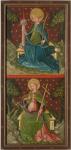
St. Catherine of Alexandria and St. Dorothy; left stationary wing of a winged altarpiece
Inv. 54.11
136 x 59 cm
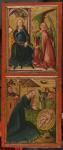
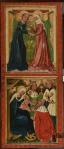
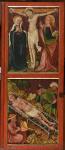
As the professional literature had earlier supposed, the stationary wings with depictions of female saints (54.11 and 54.12) and the predella showing Christ and the apostles (54.13) originally belonged to the same altarpiece. On the reverse of the stationary wings a simple red-green vine ornamentation, while the framing is clearly from a later period. The correspondence in size and the stylistic similarities suggest that the movable wings showing scenes from the infancy of Jesus (56.493 and 55.494) on the feast-day sides belonged to the same retable. This is supported by the description in the inventory of the Ipolyi collection, too. In the collection of Blasius Höfel, however, the four altarpiece wings and the predella appeared together with a shrine showing the coronation of Mary in one complete winged altarpiece. Thus far the shrine has not been identified. The structure of the predella, however, indicates that the altar did not have a shrine at its centre, but rather a painted image.
According to the auction catalogue for the Höfel collection, another predella containing twenty-three figures and showing the relationship between Mary and Jesus belonged to the retable (ein langes Gemahlde mit 23 Figuren, die Freunschaft Maria’), but its fate is similarly unknown.
Provenance:
The altarpiece wings and the predella all belonged first to Blasius Höfel and were then acquired by Lehmann and finally by Ipolyi. In the Ipolyi collection they were assigned the following inventory numbers: 88, 92 and 107. ('88. és 92. Oltárszárny-pár két-két női szent képével, hátul primitíven festett ornament. Hátsó, mozdíthatatlan szárnyak, amelyek egykor a 68 és 91. sz. alatti mozgószárnyakhoz tartoztak. XV.-XVI. század.'; '107. Predella fából, rajta festve Krisztus és a tizenkét apostol. XV-XVI. sz. Valószínűleg hazai.'/‘88 and 92. Pair of altarpiece wings each with a painting of two female saints and primitively painted ornaments on the reverse. Behind were stationary wings that once belonged to the movable wings numbered 68 and 91. 15th-16th century.’; ‘107. Predella made of wood, on it a painting of Christ with the twelve apostles. 15th-16th c. Probably local [Hungarian].’) See: Lakatos-Balla-2012 281, 292.
Bibliography:
Verzeichniss-1839, 13. sz. - Frimmel-1914, 175-176. – Benesch-1929, 68. – Gerevich-1930, 87. – Pigler-1934,131-132 – Genthon-1948 22, 23 – Radocsay-1955, 78 – Czobor-1955, 13. – Boskovits-Mojzer-Mucsi-1964, 152 (Osztrák v. magyar festő). Mucsi-1975, 23. – Lakatos-Balla-2012 281, 292.
As the professional literature had earlier supposed, the stationary wings with depictions of female saints (54.11 and 54.12) and the predella showing Christ and the apostles (54.13) originally belonged to the same altarpiece. On the reverse of the stationary wings a simple red-green vine ornamentation, while the framing is clearly from a later period. The correspondence in size and the stylistic similarities suggest that the movable wings showing scenes from the infancy of Jesus (56.493 and 55.494) on the feast-day sides belonged to the same retable. This is supported by the description in the inventory of the Ipolyi collection, too. In the collection of Blasius Höfel, however, the four altarpiece wings and the predella appeared together with a shrine showing the coronation of Mary in one complete winged altarpiece. Thus far the shrine has not been identified. The structure of the predella, however, indicates that the altar did not have a shrine at its centre, but rather a painted image.
According to the auction catalogue for the Höfel collection, another predella containing twenty-three figures and showing the relationship between Mary and Jesus belonged to the retable (ein langes Gemahlde mit 23 Figuren, die Freunschaft Maria’), but its fate is similarly unknown.
Provenance:
The altarpiece wings and the predella all belonged first to Blasius Höfel and were then acquired by Lehmann and finally by Ipolyi. In the Ipolyi collection they were assigned the following inventory numbers: 88, 92 and 107. ('88. és 92. Oltárszárny-pár két-két női szent képével, hátul primitíven festett ornament. Hátsó, mozdíthatatlan szárnyak, amelyek egykor a 68 és 91. sz. alatti mozgószárnyakhoz tartoztak. XV.-XVI. század.'; '107. Predella fából, rajta festve Krisztus és a tizenkét apostol. XV-XVI. sz. Valószínűleg hazai.'/‘88 and 92. Pair of altarpiece wings each with a painting of two female saints and primitively painted ornaments on the reverse. Behind were stationary wings that once belonged to the movable wings numbered 68 and 91. 15th-16th century.’; ‘107. Predella made of wood, on it a painting of Christ with the twelve apostles. 15th-16th c. Probably local [Hungarian].’) See: Lakatos-Balla-2012 281, 292.
Bibliography:
Verzeichniss-1839, 13. sz. - Frimmel-1914, 175-176. – Benesch-1929, 68. – Gerevich-1930, 87. – Pigler-1934,131-132 – Genthon-1948 22, 23 – Radocsay-1955, 78 – Czobor-1955, 13. – Boskovits-Mojzer-Mucsi-1964, 152 (Osztrák v. magyar festő). Mucsi-1975, 23. – Lakatos-Balla-2012 281, 292.