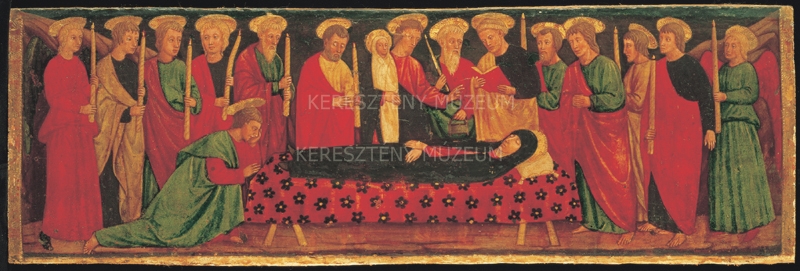
Death of the Virgin
tempera and gold on wood
22 x 67 cm
Inv. 55.162
The representation of the death of Virgin is based on apocryphal sources and spread in Italy under the influence of Byzantine art. The Virgin lies in the center in front of a row of candle-holding apostles and angels. Christ appears in the centre to take his mother’s soul shown in the form of a child. The characters fill the entire, narrow pictorial field, and are shown with little variation. The painter’s palette is limited to a few simple colours – red, green and yellow. The picture originally belonged to the altarpiece of the chapel Santa Maria alle Querce in Florence, which was painted in 1460 at the order of the Mannelli family by a late follower of Masolino, Paolo Schiavo. The signed and dated central panel of the altarpiece shows the Assumption of the Virgin (today Museo di Sant’Apollonia, Florence). The predella of the now dismembered altarpiece originally showed the three preceding scenes of the Virgin’s life: in the first picture, an angel announced to Mary her approaching death (lost); next came this scene showing the Virgin’s death; the third scene depicted the funeral of the Virgin (today Erzbischöfliches Diözesanmuseum, Cologne).
D.S.