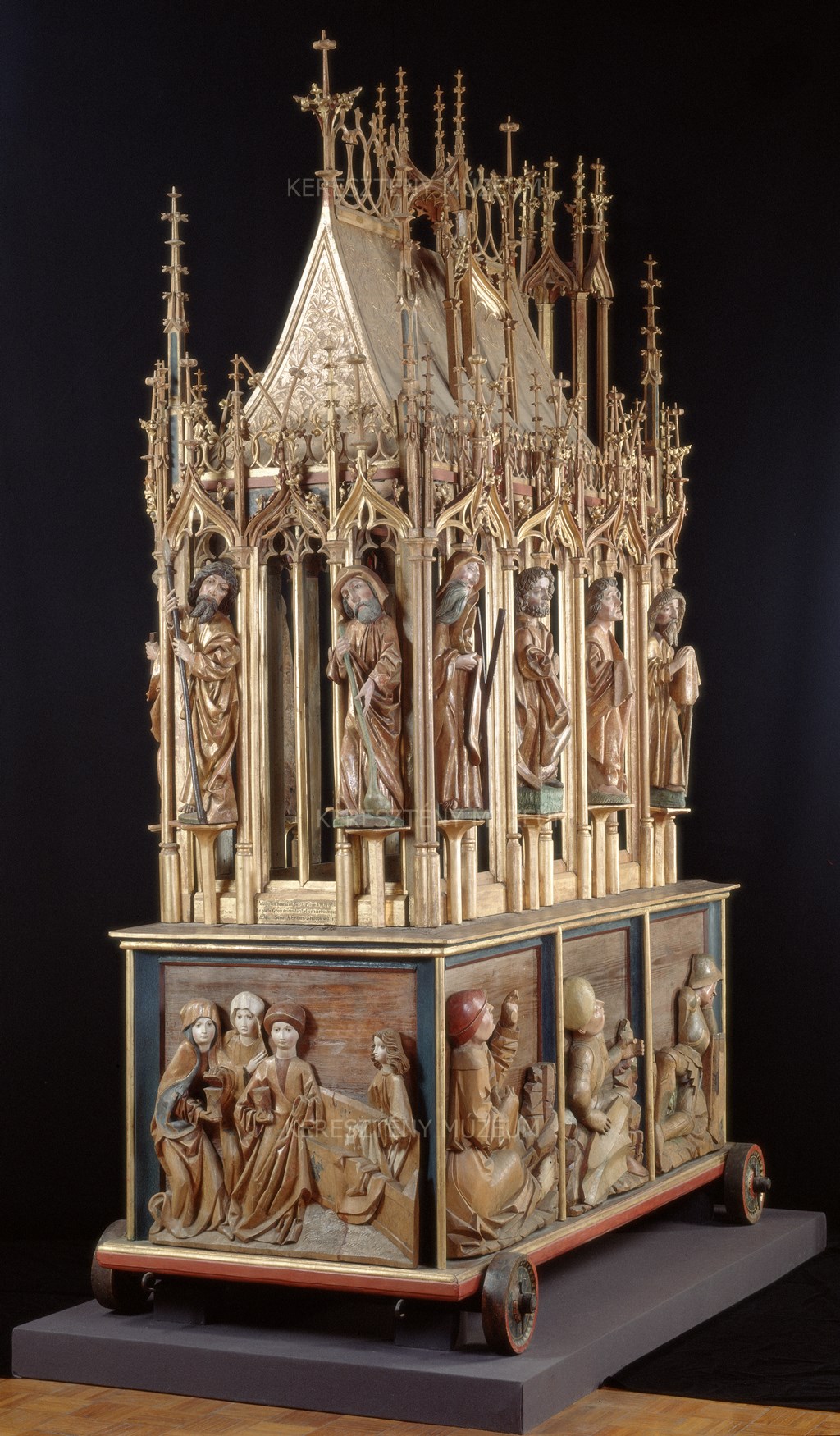
Lord’s Coffin from the Benedictine Abbey of Garamszentbenedek
1480-90
Limewood, pine, painted, gilt
Inv. On deposit from the Diocese of Esztergom
The Holy Sepulchre, known as the Lord’s Coffin, from the Benedictine Abbey of Garamszentbenedek, is the only surviving late medieval example from Hungary of the free-standing, wooden type of Holy Sepulchre, which was rare in the rest of Europe as well. The few surviving analogous works are from Zwickau, Chemnitz and Salzburg.
Numerous hypotheses have been posited about how the Lord’s Coffin was originally used; researchers agree, however, that its function was connected to the Easter liturgy: on Good Friday the statue of Christ with movable arms, also medieval in origin and preserved in Garamszentbenedek, was placed in the sarcophagus and remained there until dawn on Easter day. The exact function of numerous structural elements are to this day unclear.
The construction of the Lord’s Coffin is most likely connected to the workshop of Körmöcbánya and involved several sculptors, cabinet-makers and painters/gilders.
The two statue niches on the so-called entrance side of the coffin and the statues of the standing saints they contain were made in the sculptural workshop of Johann Hutterer when the work was restored in Vienna. Numerous other details were also later additions. Identification of the original elements would require a thorough restorer’s examination.
Provenance:
Transferred to Esztergom Basilica’s Chapel of St. Stephen by Prince Primate János Simor in 1871; acquired from there by the Christian Museum in 1974.
Restoration:
Johann Hutterer (Vienna), 1872 (Significant additions were made, missing elements were re-carved, the surfaces repainted and gilt, and the superstructure reinforced with planks.) The inscription on the Lord’s Coffin documents these procedures: Aediculam hanc olim Ecclesiae Conv. S. S. Benedicti de juxta Gran suam fecit et reficiendam jussit Joan. simor A. Eppus Strigon. a.d. 1872.
Kálmán Németh, 1954
Dezső Varga and students from the University of Fine Arts, 1974-79
Bibliography
Henszlmann, E. Die mittelalterliche Baukunst in Ungarn. Oesterreichische Revue IV/X (1866) 138-140. – Mykovszky Viktor: Szent-Benedek. Hazánk s a Külföld V 1869. 552-554. kép: 549. – Dankó József: Magyar szertartási régiségek. B) A nagypénteki isteni szolgálat. In: Új Magyar Sion 1871. (161-182.) 175-182. – Dankó József: A húsvéti isteni szolgálat a régi magyar egyházban, Esztergom, 1872. 44-48. – Dankó József: Die Feier des Osterfestes nach der alten römisch-ungarischen Liturgie. Oesterreichische Vierteljahresschrift für Katholische Theologie XI. Wien 1872, 177-181. – Henszlmann I. A bécsi 1873. évi világ-tárlatnak magyarországi kedvelőinek régészeti osztálya. Budapest, 1875-76. 193. – Dankó József: Münster und Abtei S. Benedicti, Szent Benedek, an der Gran. Ungarische Revue XIII 1873. 18-19. – Czobor Béla: A középkori egyházi művészet kézikönyve. Budapest, 1875. 196. I. – Ipolyi Arnold: A besztercebányai egyházi műemlékek története és helyreállítása. MTA Könyvkiadó Hiv. Budapest, 1878. 78. – Divald Kornél: A fafaragás. Az iparművészet könyve II. (szerk. Ráth Gy.) Budapest, 1905. 132-133. XX.t. – Divald Kornél: Csúcsíveskori szárnyasoltárok Bars és Turóc vármegyében. MMÉEK XLV 1911. 539, 545-547, 548. Pic. 11-13. – Divald Kornél: Magyarország csúcsíveskori szárnyasoltárai 1911. 44-45. – Haiczl Kálmán: A garamszentbenedeki apátság története. Élet, Budapest, 1913. 132-134. – Brooks, Neil Conwell: The Sepulchre of Christ in Art and Liturgy, with Special Reference to the Liturgic Drama. University of Illinois 1921. 63. Pic.16. – Zalán Menyhért: A Pray-kódex feltámadási szertartásai. Pannonhalmi Szemle, 1927. 98. – Gerevich Tibor: Esztergomi műkincsek. Prímás Album. Budapest, 1928. (179-263.) 219. – Edvi-Illés Gyula. Az esztergomi főszékesegyház. Prímás Album. Budapest, 1928. 151-177. 173. – Edvi-Illés Gyula: Az esztergomi főszékesegyház. Budapest, 1929. 28. – Péter András: A magyar művészet története I. Budapest, 1930. 156. Pic.82. –Wagner V.: Dejiny vytvarného umenia na Slovensku. Trnava 1930. 73-74 77. – Kampis Antal: A középkori magyar faszobrászat történetének vázlata 1450-ig. Budapest, 1932. 21. – Wagner V.: Vrcholne gotická drevená plastika na Slovensku. (Kny. Sbornik Matice Slovenskej) T. Sv. Martin 1936. 27. –Schürer O.-Wiese E.: Deutsche Kunst in der Zips. Brünn-Wien-Leipzig, 1938. 73-194, 197. – Horváth E. Il rinascimento in Ungheria. Annuario III. Roma 1939. 140. – Kampis Antal-1940 64-65. 66 148 Pic. 220. –Gerevich László: A garamszentbenedeki úrkoporsó. In: Gerevich Tibor et. al.: Emlékkönyv Gerevich Tibor születésének hatvanadik fordulójára. 1942. 43-59. – Gerevich László: A felvidéki szobrászat stílusfejlődése. Budapest 1943. 16. – Schwarzweber, Annemarie: Das heilige Grab in der deutschen Bildnerei des Mittelalters. Freiburg in Breisgau, 1944. 43-44. – Radocsay-1955a 12. – Aggházy Mária: Régi magyarországi faszobrok. Budapest, 1958. 17. 22. – Radocsay Dénes: Sur quelques statues de bois gothiques. BMHB (Bulletin du Musée Hongrois des Beaux-Arts) 14(1959) 46. –Trajdos E. : Wit Stosz inscenizatiorem? Pamietnik Teatralny XIII (1964) 335-341. – Radocsay-1967. 9, 56, 74-76, 166-167. – Taubert, Gesine u. Johannes: Mittelalterliche Kruzifixe mit schwenkbaren Armen. Ein Beitrag zur Verwendung von Bildwerken in der Liturgie. In: Zeitschrift des Deutschen Vereins für Kunstwissenschaft, 23 (1969) 79-121. – Taubert, Johannes: Farbige Skulpturen. München 1978. 48. – Prokopp Mária: A garamszentbenedeki Úrkoporsó az Esztergomi Keresztény Múzeumban. Corvina, Budapest, 1982. – Marosi Ernő: Megjegyzések a középkori magyarországi művészet liturgiai vonatkozásaihoz. In: Tüskés Gábror, Fazekas István (szerk.) „Mert ezt Isten hagyta…” Tanulmányok a népi vallásosság köréből. Budapest, Magvető 1986. (88-116.) 111. – Bodorné Szent-Gály Erzsébet: A garamszentbenedeki „megostorozott Krisztus” szobor a Keresztény Múzeumban. In.: Művészettörténeti Értesítő 30(1981) 60-62. – Bodorné Szent-Gály Erzsébet: Szent Benedek Úrháza. Adatok a garamszentbenedeki úrkoporsó liturgikus használatához. In: Művészettörténeti Értesítő 36(1987) 155-157. – Cséfalvay-1993. 178-179. – Tripps, Johannes: Das handelnde Bildwerk in der Gotik. Forschungen zu den Bedeutungsschichten und der Funktion des Kirchengebäudes und seiner Ausstattung in der Hoch- und Spätgotik, Berlin, 1998. 116. – Dobszay László: Liber Ordinarius Agriensis 1509. (Musicalia Danubiana). MTA Zenetudományi Intézet, Budapest, 2000. 59. – Kroesen, Justin E. A.: The Sepulchrum Domini Through the Ages. Its Form and Function. (Liturgia condenda 10.) Peeters, Leuven, 2000. 102. 105. 164-165. – Takács Imre: Garamszentbenedek temploma és liturgikus berendezése. In: Pannonhalma, 2001. (159-186.) 180-182. – Glaser, Franz: Das monumentale Grabmal des Alboin (+ 975) in Möchling. In: Rudolfinum- Jahrbuch des Landesmuseums für Kärnten, 2003. (101-106.) 106. http://www.landesmuseum.at/pdf_frei_remote/Rudolfinum_2003_0101-0106.pdf . – Heckmann-von Wehren, Irmhild: Das Heilige Grab der St Jakobikirche zu Chemnitz und seine typologische Einordnung im Kontext des deutschprachigen Kulturraumes. Anmerkungen zur Entstehungs- und Restaurierungsgeschichte sowie zu Stil- und Motivfragen. In: Denkmalpflege in Sachsen. Mitteilungen des Landesamtes für Denkmalpflege Sachsen, 2003. 37-38. Pozsony 2003, 716-717 (Endrődi G.). – Juhos Rózsa: Sepulchrum. Középkori szentsírok a nagypénteki és húsvéti szertartásban. Diplomamunka (ELTE-BTK Művészettörténeti Intézet) 2013. – Juhos Rózsa: A garamszentbenedeki Úrkoporsó. A használat rekonstrukciójának lehetőségei. In: Ars Hungarica 2016/4, 339 - 352.
Great Exhibition, Vienna 1873
Numerous hypotheses have been posited about how the Lord’s Coffin was originally used; researchers agree, however, that its function was connected to the Easter liturgy: on Good Friday the statue of Christ with movable arms, also medieval in origin and preserved in Garamszentbenedek, was placed in the sarcophagus and remained there until dawn on Easter day. The exact function of numerous structural elements are to this day unclear.
The construction of the Lord’s Coffin is most likely connected to the workshop of Körmöcbánya and involved several sculptors, cabinet-makers and painters/gilders.
The two statue niches on the so-called entrance side of the coffin and the statues of the standing saints they contain were made in the sculptural workshop of Johann Hutterer when the work was restored in Vienna. Numerous other details were also later additions. Identification of the original elements would require a thorough restorer’s examination.
Provenance:
Transferred to Esztergom Basilica’s Chapel of St. Stephen by Prince Primate János Simor in 1871; acquired from there by the Christian Museum in 1974.
Restoration:
Johann Hutterer (Vienna), 1872 (Significant additions were made, missing elements were re-carved, the surfaces repainted and gilt, and the superstructure reinforced with planks.) The inscription on the Lord’s Coffin documents these procedures: Aediculam hanc olim Ecclesiae Conv. S. S. Benedicti de juxta Gran suam fecit et reficiendam jussit Joan. simor A. Eppus Strigon. a.d. 1872.
Kálmán Németh, 1954
Dezső Varga and students from the University of Fine Arts, 1974-79
Bibliography
Henszlmann, E. Die mittelalterliche Baukunst in Ungarn. Oesterreichische Revue IV/X (1866) 138-140. – Mykovszky Viktor: Szent-Benedek. Hazánk s a Külföld V 1869. 552-554. kép: 549. – Dankó József: Magyar szertartási régiségek. B) A nagypénteki isteni szolgálat. In: Új Magyar Sion 1871. (161-182.) 175-182. – Dankó József: A húsvéti isteni szolgálat a régi magyar egyházban, Esztergom, 1872. 44-48. – Dankó József: Die Feier des Osterfestes nach der alten römisch-ungarischen Liturgie. Oesterreichische Vierteljahresschrift für Katholische Theologie XI. Wien 1872, 177-181. – Henszlmann I. A bécsi 1873. évi világ-tárlatnak magyarországi kedvelőinek régészeti osztálya. Budapest, 1875-76. 193. – Dankó József: Münster und Abtei S. Benedicti, Szent Benedek, an der Gran. Ungarische Revue XIII 1873. 18-19. – Czobor Béla: A középkori egyházi művészet kézikönyve. Budapest, 1875. 196. I. – Ipolyi Arnold: A besztercebányai egyházi műemlékek története és helyreállítása. MTA Könyvkiadó Hiv. Budapest, 1878. 78. – Divald Kornél: A fafaragás. Az iparművészet könyve II. (szerk. Ráth Gy.) Budapest, 1905. 132-133. XX.t. – Divald Kornél: Csúcsíveskori szárnyasoltárok Bars és Turóc vármegyében. MMÉEK XLV 1911. 539, 545-547, 548. Pic. 11-13. – Divald Kornél: Magyarország csúcsíveskori szárnyasoltárai 1911. 44-45. – Haiczl Kálmán: A garamszentbenedeki apátság története. Élet, Budapest, 1913. 132-134. – Brooks, Neil Conwell: The Sepulchre of Christ in Art and Liturgy, with Special Reference to the Liturgic Drama. University of Illinois 1921. 63. Pic.16. – Zalán Menyhért: A Pray-kódex feltámadási szertartásai. Pannonhalmi Szemle, 1927. 98. – Gerevich Tibor: Esztergomi műkincsek. Prímás Album. Budapest, 1928. (179-263.) 219. – Edvi-Illés Gyula. Az esztergomi főszékesegyház. Prímás Album. Budapest, 1928. 151-177. 173. – Edvi-Illés Gyula: Az esztergomi főszékesegyház. Budapest, 1929. 28. – Péter András: A magyar művészet története I. Budapest, 1930. 156. Pic.82. –Wagner V.: Dejiny vytvarného umenia na Slovensku. Trnava 1930. 73-74 77. – Kampis Antal: A középkori magyar faszobrászat történetének vázlata 1450-ig. Budapest, 1932. 21. – Wagner V.: Vrcholne gotická drevená plastika na Slovensku. (Kny. Sbornik Matice Slovenskej) T. Sv. Martin 1936. 27. –Schürer O.-Wiese E.: Deutsche Kunst in der Zips. Brünn-Wien-Leipzig, 1938. 73-194, 197. – Horváth E. Il rinascimento in Ungheria. Annuario III. Roma 1939. 140. – Kampis Antal-1940 64-65. 66 148 Pic. 220. –Gerevich László: A garamszentbenedeki úrkoporsó. In: Gerevich Tibor et. al.: Emlékkönyv Gerevich Tibor születésének hatvanadik fordulójára. 1942. 43-59. – Gerevich László: A felvidéki szobrászat stílusfejlődése. Budapest 1943. 16. – Schwarzweber, Annemarie: Das heilige Grab in der deutschen Bildnerei des Mittelalters. Freiburg in Breisgau, 1944. 43-44. – Radocsay-1955a 12. – Aggházy Mária: Régi magyarországi faszobrok. Budapest, 1958. 17. 22. – Radocsay Dénes: Sur quelques statues de bois gothiques. BMHB (Bulletin du Musée Hongrois des Beaux-Arts) 14(1959) 46. –Trajdos E. : Wit Stosz inscenizatiorem? Pamietnik Teatralny XIII (1964) 335-341. – Radocsay-1967. 9, 56, 74-76, 166-167. – Taubert, Gesine u. Johannes: Mittelalterliche Kruzifixe mit schwenkbaren Armen. Ein Beitrag zur Verwendung von Bildwerken in der Liturgie. In: Zeitschrift des Deutschen Vereins für Kunstwissenschaft, 23 (1969) 79-121. – Taubert, Johannes: Farbige Skulpturen. München 1978. 48. – Prokopp Mária: A garamszentbenedeki Úrkoporsó az Esztergomi Keresztény Múzeumban. Corvina, Budapest, 1982. – Marosi Ernő: Megjegyzések a középkori magyarországi művészet liturgiai vonatkozásaihoz. In: Tüskés Gábror, Fazekas István (szerk.) „Mert ezt Isten hagyta…” Tanulmányok a népi vallásosság köréből. Budapest, Magvető 1986. (88-116.) 111. – Bodorné Szent-Gály Erzsébet: A garamszentbenedeki „megostorozott Krisztus” szobor a Keresztény Múzeumban. In.: Művészettörténeti Értesítő 30(1981) 60-62. – Bodorné Szent-Gály Erzsébet: Szent Benedek Úrháza. Adatok a garamszentbenedeki úrkoporsó liturgikus használatához. In: Művészettörténeti Értesítő 36(1987) 155-157. – Cséfalvay-1993. 178-179. – Tripps, Johannes: Das handelnde Bildwerk in der Gotik. Forschungen zu den Bedeutungsschichten und der Funktion des Kirchengebäudes und seiner Ausstattung in der Hoch- und Spätgotik, Berlin, 1998. 116. – Dobszay László: Liber Ordinarius Agriensis 1509. (Musicalia Danubiana). MTA Zenetudományi Intézet, Budapest, 2000. 59. – Kroesen, Justin E. A.: The Sepulchrum Domini Through the Ages. Its Form and Function. (Liturgia condenda 10.) Peeters, Leuven, 2000. 102. 105. 164-165. – Takács Imre: Garamszentbenedek temploma és liturgikus berendezése. In: Pannonhalma, 2001. (159-186.) 180-182. – Glaser, Franz: Das monumentale Grabmal des Alboin (+ 975) in Möchling. In: Rudolfinum- Jahrbuch des Landesmuseums für Kärnten, 2003. (101-106.) 106. http://www.landesmuseum.at/pdf_frei_remote/Rudolfinum_2003_0101-0106.pdf . – Heckmann-von Wehren, Irmhild: Das Heilige Grab der St Jakobikirche zu Chemnitz und seine typologische Einordnung im Kontext des deutschprachigen Kulturraumes. Anmerkungen zur Entstehungs- und Restaurierungsgeschichte sowie zu Stil- und Motivfragen. In: Denkmalpflege in Sachsen. Mitteilungen des Landesamtes für Denkmalpflege Sachsen, 2003. 37-38. Pozsony 2003, 716-717 (Endrődi G.). – Juhos Rózsa: Sepulchrum. Középkori szentsírok a nagypénteki és húsvéti szertartásban. Diplomamunka (ELTE-BTK Művészettörténeti Intézet) 2013. – Juhos Rózsa: A garamszentbenedeki Úrkoporsó. A használat rekonstrukciójának lehetőségei. In: Ars Hungarica 2016/4, 339 - 352.
Great Exhibition, Vienna 1873