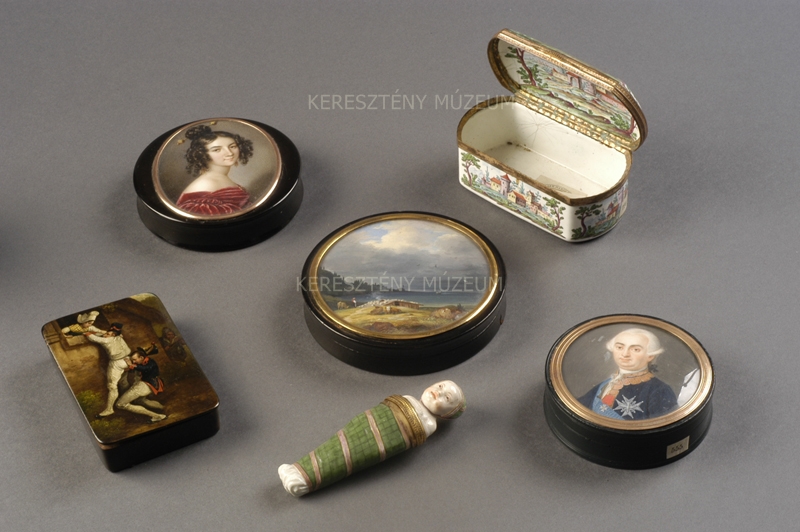
Caskets and snuff boxes
18-19th c.
Caskets and snuff boxes are intimate objects. They were popular gifts and usually had two functions: men kept snuff (ground tobacco) in them, while women used them primarily for storing face powder. They flourished in the 18th and 19th centuries. They were made of precious metals, semi-precious stones, porcelain, lacquer, ivory, boxwood, or glass, and were decorated – often by famous masters – with miniatures, carvings, engravings or mosaics. The miniatures often represented a male portrait (if given by a woman) or a female portrait (if presented by a man to a woman). This fashionable article was widespread in Germany, Austria, France and Italy. The Christian Museum has nearly 500 caskets and snuff boxes; they were all acquired from the San Marco collection.
P.Cs.