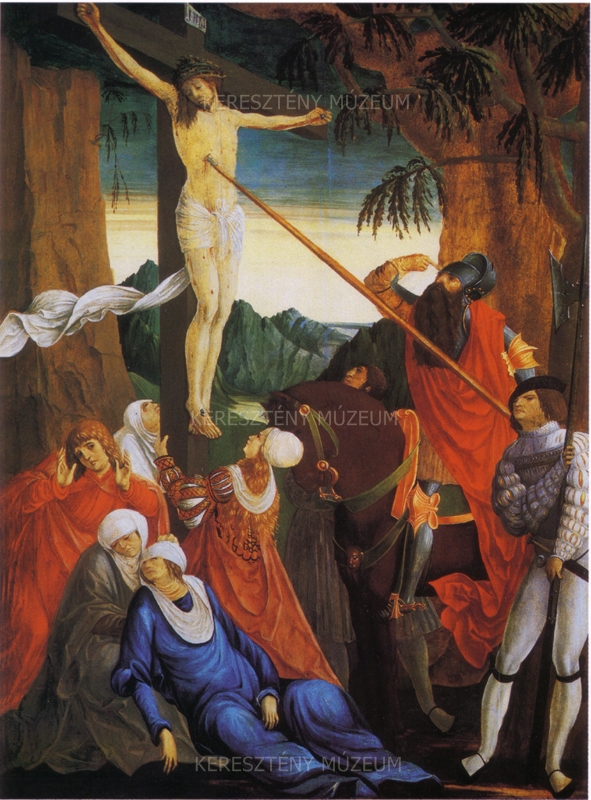
Crucifixion
after 1502
tempera on wood
120 x 92.5 cm
Inv. 56.471
The work depicting the Crucifixion was painted by a workshop member or a follower of Master Jörg Breu the Elder from Augsburg. The unknown German or Austrian painter took Breu’s early works – among them, the high altarpiece of Melk from 1502 – as a model. The details are less carefully executed here, the figures are slimmer and more softly represented, and the drawing is less hard or contoured. Certain characteristics of the early period of the so called Danube school, which determined the style of painting in the Bavarian and Austrian regions of the Danube from around 1490 to 1540, can also be observed in this picture, such as the bright colors, the soft patches of light, and the combination of diagonal and vertical compositional patterns. It was the growingly realistic representation of landscape in such biblical scenes that eventually lead to the development of independent landscape painting. Here the naked bluish rocks of the far background render distance perceptible. The ancient tree trunks of the middle distance close off the actual scene of the event. While the cross seems to reach up to the sky, the foliage that leans towards it gives the impression that it is also close our earthly sphere. The cross is not at the axis of the composition, as usual in medieval pictures, but shown in foreshortening, slightly turned to the side. The mourning women, Saint John the Evangelist, and the swooning Virgin on the ground are all crowded into one group on the left. They are balanced by the soldier with the halberd and the powerful riding figure of Longinus on the right. According to the legend, Longinus’s blindness was cured by the blood that broke forth from Christ’s side when he stabbed it with his spear.
I.K.