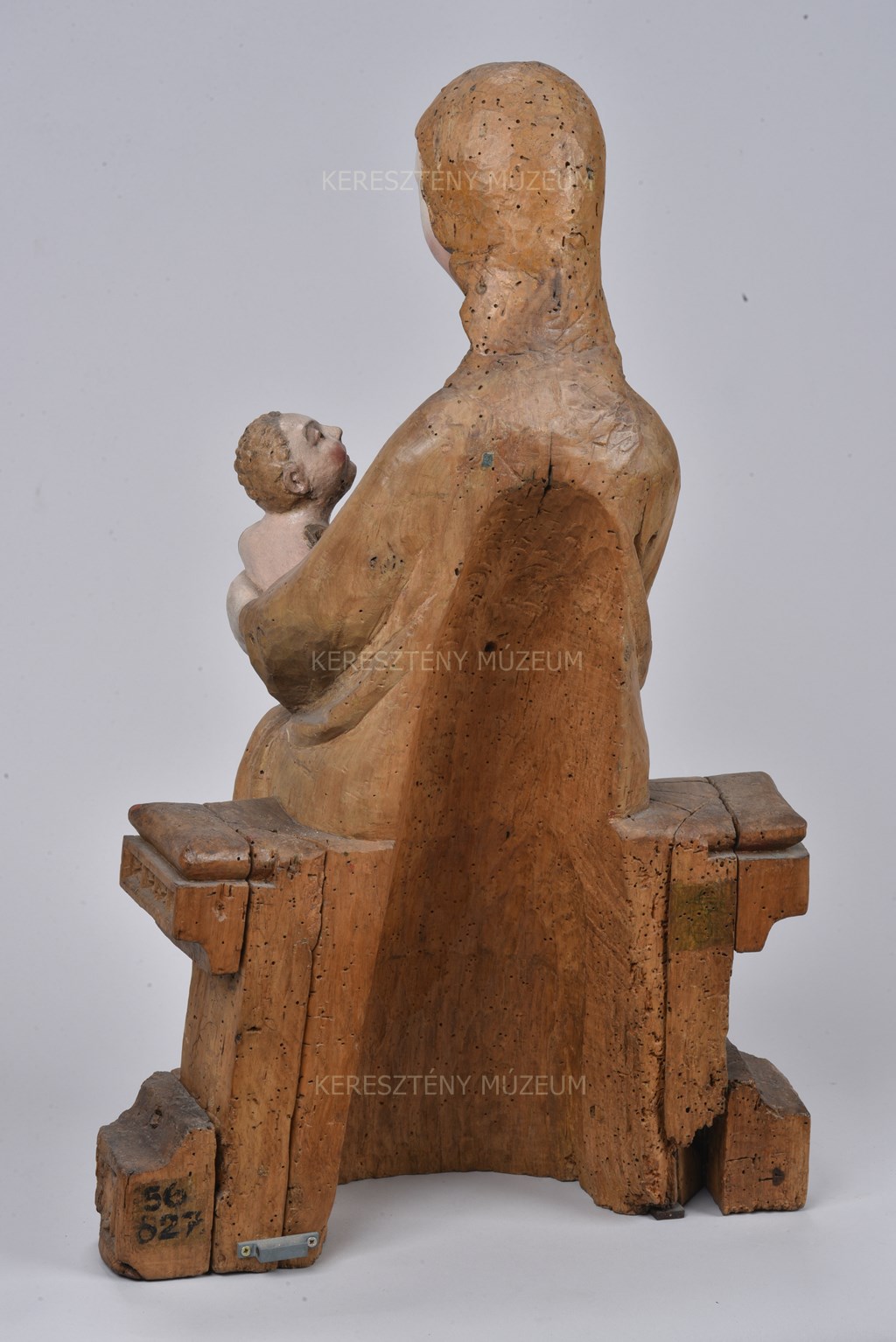
Nursing Madonna (Maria Lactans)
c. 1350
Wood, formerly polychrome
65 x 41 x 16 cm
Inv. 56.827
The statue of the enthroned Mary nursing her child may have been redesigned and repainted in the 18th-19th centuries. A bird was placed in the nursing Virgin’s right hand, which had once held her breast. The original, presumably badly worn paint was removed, and the statue may have been somewhat re-carved and later completely repainted. The work was repaired and repainted several times over the years. During restoration in the 1970s, several layers of paint were removed. (This information is based on Péter Menráth’s oral account.)
Provenance:
Unknown. According to tradition, it belonged to the Ipolyi collection. However, the item cannot be identified with any certainty in the collection’s published records. Kornél Divald believes the statue originated in Zólyom County, although it appears that the information he provides does not relate to this statue. In Antal Kampis’s opinion, János Simor purchased the statue in Cologne from Schnütgen. Dénes Radocsay supports a Hungarian origin for the statue based solely on the tradition that it belonged to the Ipolyi collection.
Restoration:
In the 1970s Péter Menráth took off several thick layers of added paint and restored the original composition: the bird was removed and Mary’s hand was returned to its original nursing gesture.
Bibliography:
Gerevich 1928, 216-218. –Egyházművészeti kiállítás (Exh. cat. Budapest: Iparművészeti Múzeum, 1930. May - September), Budapest, 1930, Nr. 9. – Gerevich Tibor: Magyarország románkori emlékei, Budapest, 1938, 208. – Genthon 1948, 146. – Aggházy Mária: Régi magyarországi faszobrok, Budapest, 1958, 20. – Kampis Antal: Aggházy Mária: Régi magyarországi faszobrok (review). In: Művészettörténeti Értesítő 9 (1960), 79. – Boskovits-Mojzer-Mucsi 1964, 7. (only illustration). – Musée d’Ethnographie de Neuchâtel. L’art médiéval en Hongrie de l’an 1000 à 1526, Neuchâtel, 1965, 71. – L’art de Hongrie du Xe au XXe siècle, Paris, 1966, 91. sz. – A magyar művészet kiállítása Párizsban (Kiáll. kat. Budapest: Szépművészeti Múzeum), Budapest, 1966, 17. (Exh. cat. Nr. 63.) – Radocsay Dénes: A középkori Magyarország faszobrai, Budapest, 1967, 38, 170. – Zuzana Ševčiková: 13. századi trónoló Madonna-szobor Dunajská Lužnán. A „misérdi Madonna” újrafelfedezése. In: Művészettörténeti Értesítő 45 (1996), 270.
Provenance:
Unknown. According to tradition, it belonged to the Ipolyi collection. However, the item cannot be identified with any certainty in the collection’s published records. Kornél Divald believes the statue originated in Zólyom County, although it appears that the information he provides does not relate to this statue. In Antal Kampis’s opinion, János Simor purchased the statue in Cologne from Schnütgen. Dénes Radocsay supports a Hungarian origin for the statue based solely on the tradition that it belonged to the Ipolyi collection.
Restoration:
In the 1970s Péter Menráth took off several thick layers of added paint and restored the original composition: the bird was removed and Mary’s hand was returned to its original nursing gesture.
Bibliography:
Gerevich 1928, 216-218. –Egyházművészeti kiállítás (Exh. cat. Budapest: Iparművészeti Múzeum, 1930. May - September), Budapest, 1930, Nr. 9. – Gerevich Tibor: Magyarország románkori emlékei, Budapest, 1938, 208. – Genthon 1948, 146. – Aggházy Mária: Régi magyarországi faszobrok, Budapest, 1958, 20. – Kampis Antal: Aggházy Mária: Régi magyarországi faszobrok (review). In: Művészettörténeti Értesítő 9 (1960), 79. – Boskovits-Mojzer-Mucsi 1964, 7. (only illustration). – Musée d’Ethnographie de Neuchâtel. L’art médiéval en Hongrie de l’an 1000 à 1526, Neuchâtel, 1965, 71. – L’art de Hongrie du Xe au XXe siècle, Paris, 1966, 91. sz. – A magyar művészet kiállítása Párizsban (Kiáll. kat. Budapest: Szépművészeti Múzeum), Budapest, 1966, 17. (Exh. cat. Nr. 63.) – Radocsay Dénes: A középkori Magyarország faszobrai, Budapest, 1967, 38, 170. – Zuzana Ševčiková: 13. századi trónoló Madonna-szobor Dunajská Lužnán. A „misérdi Madonna” újrafelfedezése. In: Művészettörténeti Értesítő 45 (1996), 270.