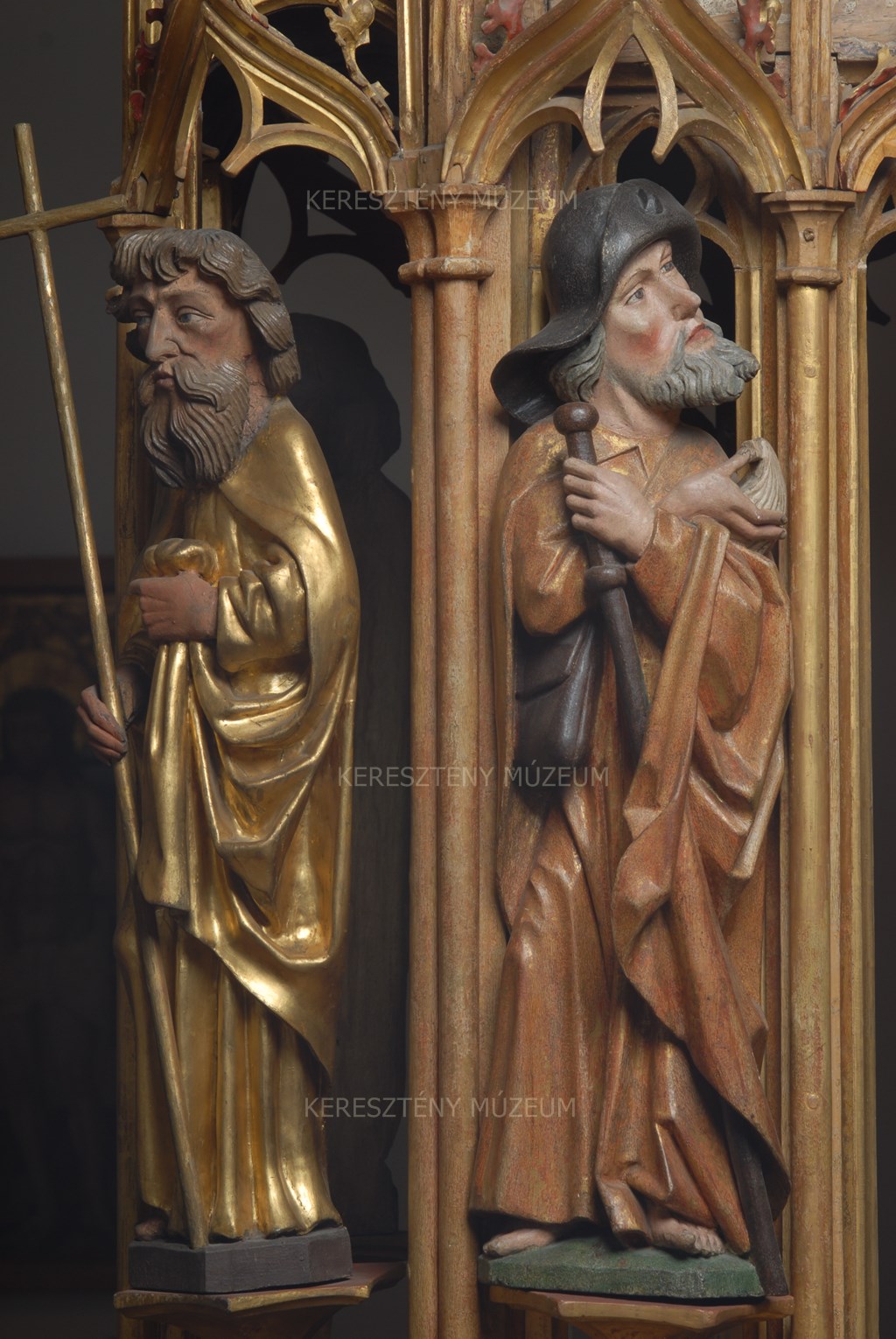
Lord’s Coffin from the Benedictine Abbey of Garamszentbenedek
1480-90
Limewood, pine, painted, gilt
Inv. On deposit from the Diocese of Esztergom
The Holy Sepulchre, known as the Lord’s Coffin, from the Benedictine Abbey of Garamszentbenedek, is the only surviving late medieval example from Hungary of the free-standing, wooden type of Holy Sepulchre, which was rare in the rest of Europe as well. The few surviving analogous works are from Zwickau, Chemnitz and Salzburg.
Numerous hypotheses have been posited about how the Lord’s Coffin was originally used; researchers agree, however, that its function was connected to the Easter liturgy: on Good Friday the statue of Christ with movable arms, also medieval in origin and preserved in Garamszentbenedek, was placed in the sarcophagus and remained there until dawn on Easter day. The exact function of numerous structural elements are to this day unclear.
The construction of the Lord’s Coffin is most likely connected to the workshop of Körmöcbánya and involved several sculptors, cabinet-makers and painters/gilders.
The two statue niches on the so-called entrance side of the coffin and the statues of the standing saints they contain were made in the sculptural workshop of Johann Hutterer when the work was restored in Vienna. Numerous other details were also later additions. Identification of the original elements would require a thorough restorer’s examination.
Provenance: Transferred to Esztergom Basilica’s Chapel of St. Stephen by Prince Primate János Simor in 1871; acquired from there by the Christian Museum in 1974.
Restoration:
Johann Hutterer (Vienna), 1872 (Significant additions were made, missing elements were re-carved, the surfaces repainted and gilt, and the superstructure reinforced with planks.) The inscription on the Lord’s Coffin documents these procedures: Aediculam hanc olim Ecclesiae Conv. S. S. Benedicti de juxta Gran suam fecit et reficiendam jussit Joan. simor A. Eppus Strigon. a.d. 1872.
Kálmán Németh, 1954
Dezső Varga and students from the University of Fine Arts, 1974-79
Numerous hypotheses have been posited about how the Lord’s Coffin was originally used; researchers agree, however, that its function was connected to the Easter liturgy: on Good Friday the statue of Christ with movable arms, also medieval in origin and preserved in Garamszentbenedek, was placed in the sarcophagus and remained there until dawn on Easter day. The exact function of numerous structural elements are to this day unclear.
The construction of the Lord’s Coffin is most likely connected to the workshop of Körmöcbánya and involved several sculptors, cabinet-makers and painters/gilders.
The two statue niches on the so-called entrance side of the coffin and the statues of the standing saints they contain were made in the sculptural workshop of Johann Hutterer when the work was restored in Vienna. Numerous other details were also later additions. Identification of the original elements would require a thorough restorer’s examination.
Provenance: Transferred to Esztergom Basilica’s Chapel of St. Stephen by Prince Primate János Simor in 1871; acquired from there by the Christian Museum in 1974.
Restoration:
Johann Hutterer (Vienna), 1872 (Significant additions were made, missing elements were re-carved, the surfaces repainted and gilt, and the superstructure reinforced with planks.) The inscription on the Lord’s Coffin documents these procedures: Aediculam hanc olim Ecclesiae Conv. S. S. Benedicti de juxta Gran suam fecit et reficiendam jussit Joan. simor A. Eppus Strigon. a.d. 1872.
Kálmán Németh, 1954
Dezső Varga and students from the University of Fine Arts, 1974-79