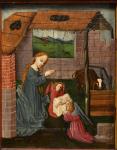
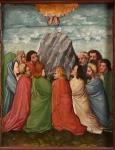
Predella with scenes from the Life of Christ
c. 1430
Pine, tempera
59.5 x 188 (47+94+47) cm
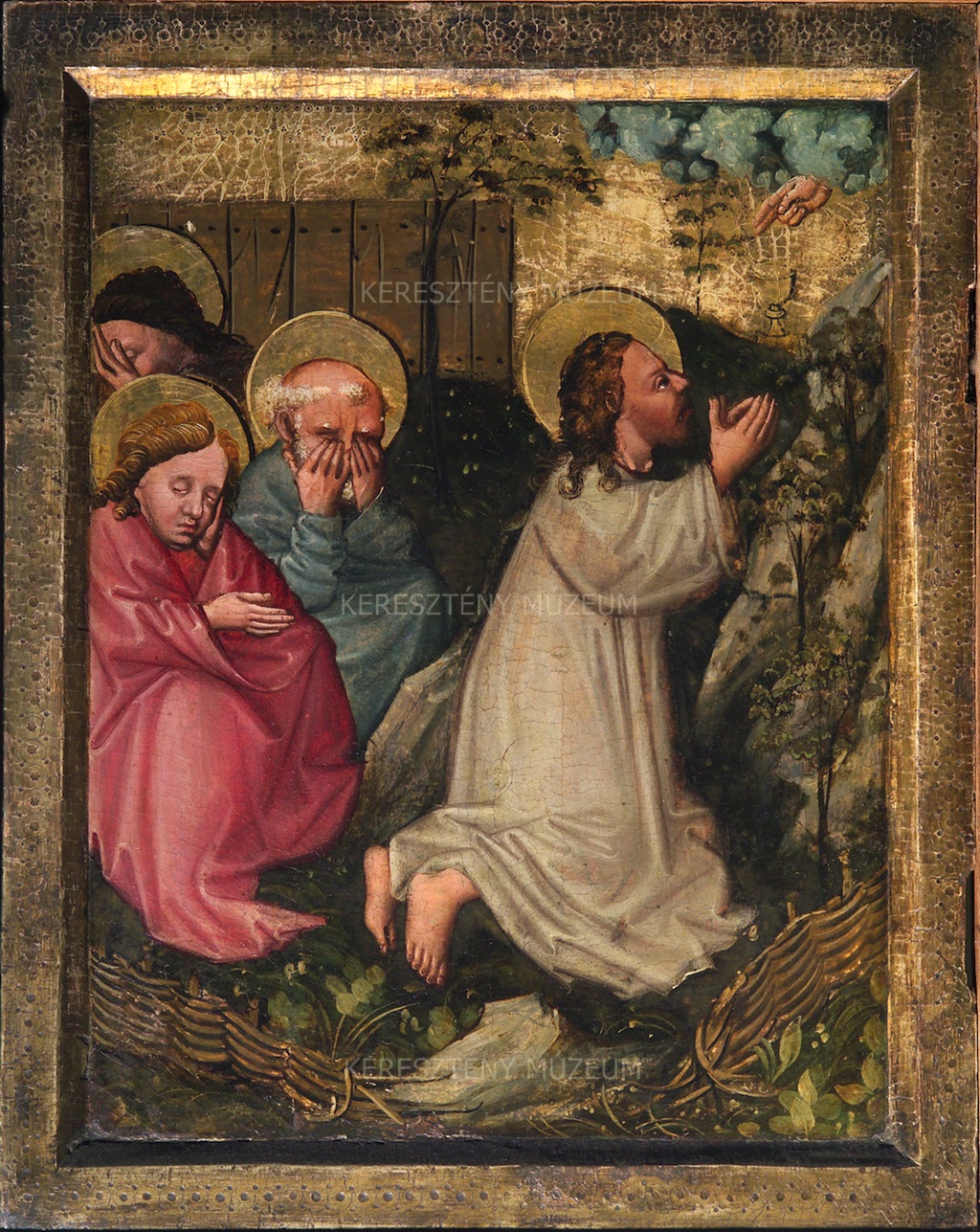
Christ on the Mount of Olives; on the reverse Evagationes Spiritus. Left movable wing of the predella
Inv. 56.495
58.5 x 46.5 cm
According to the professional literature, the panel painted on both sides may have comprised the left movable wing of diptych or triptych. Its former inner side would have shown the Mount of Olives while the outer side displayed the moralizing image known as Evagationes Spiritus. The unusual iconography of the latter, which depicts the direction and subject of the man’s straying thoughts during prayer, makes it likely that the workday side of the accompanying panel displayed two male figures beneath the cross: one properly engaged in prayer, his thoughts ascending toward the Saviour, and the other distracted, his mind occupied by the worldly vanities shown in the Christian Museum’s picture.
The style of the images, especially the similarities observed in the depiction of the scene on the Mount of Olives, the repetition of the punched edge motif and the corresponding dimensions clearly demonstrate that this wing panel was the left movable wing of the predella with inventory number 55.110. (In the literature, Miklós Csánky also proposed the possibility that the two belonged together.)
Provenance: The work had been part of the collection of Blasius Höfel in Wiener Neustadt before being acquired by Karl Lemann and then Arnold Ipolyi. -'154. Kettős kép fára festve. Tryptychon részlete. Előlap: Krisztus az Olajfák hegyén (átfestve). Hátlap: Szobában ülő zöldruhás nő, az ajtó előtt felnyergelt paripa. XV-XVI. sz. (Német?)' - ‘154. Double image painted on wood. Detail from a triptych. Verso: Christ on the Mount of Olives (repainted). Verso: Woman in green seated in a room with a saddled horse at her door. XV-XVI c (German?)’ (Lakatos-Balla-2012 275)
Restoration:
György Kákay Szabó, 1938
Bibliography:
Verzeichniss-1839, 17. – Frimmel-1914, 179. – Az 1930. évi őszi kiállítás képes tárgymutatója Budapest, 1930, Exh. cat. Nr.45.; 13. – Gerevich-1930, 86. – Benesch-1929, 68. – Genthon-1932, 46. – Pigler-1934, 121-136. – Pigler Andor: Pótlások az «Evagationes Spiritus» című cikkhez, in: Archaeologiai Értesítő 47 (1934), 169. – Éber László: Könyvismertetés az Archaeologiai Értesítő új kötetéről (review), in: Magyar Művészet 10 (1934), 255. – Guy de Tervarent, ‟En marge du catalogue du Prado,” Gazette des Beaux-Arts 78 (1936): 59-60. – Csánky Miklós: A szepesi és sárosi táblaképfestészet 1460-ig, Budapest, 1938, 9. (footnote: Nr.5. ). – Genthon-1948, 127. – Czobor-1955, 13. – Dercsényi Dezső – Zolnay László: Esztergom, Budapest, 1956, 82. – Mojzer-1958, 15. –Csendéletkiállítás, XV – XVIII. század, Exh. cat.. Szépművészeti Múzeum, editor:. Czobor Ágnes, Budapest, 1962, 9. (Exh. cat.. Nr.1.). – Boskovits-Mojzer-Mucsi-1964, 156. – Robert Wildhaber, ‟Das gute und das schlechte Gebet,” in Europäische Kulturverflechtungen im Bereich der volkstümlichen Überlieferung: Festschrift zum 65. Geburtstag Bruno Schiers, ed. Hinrich Siuts and Gerhard Heilfurth (Göttingen: Schwartz, 1967), 70. –Mucsi-1973, 22-23. – Mucsi-1975, 21. – Mucsi András: Gótikus és reneszánsz táblaképek az esztergomi Keresztény Múzeumban (XIII – XVI. század), Esztergom, 1990, 7. – Englisch, Ernst – Vocelka, Karl: Evagationes spiritus (VII. Exh. cat.. Nr.3. ). In: Die Ritter. Burgenländische Landesausstellung (Exh. cat. Burg Güssing, 1990. május 4 – október 28), Eisenstadt, 1990, 259. – Cséfalvay-1993, 186-187 (Végh János). – Leopold Kretzenbacher, ‟Drei altösterreichische Mahnbild- Zeugnisse pastoral gelenkter Volksfrömmigkeit,” Zeitschrift des Historischen Vereines für Steiermark 84 (1993): 127-139. – Gerhard Jaritz,‟Ira Dei, Material Culture, and Behavior in the Late Middle Ages: Evidence From German-speaking Europe,” Essays in Medieval Studies 18,no. 1 (2001): 53-66. – Schauplatz Mittelalter Friesach. Kärntner Landesausstellung 2001. Bd. II: Katalog (Die Stadt im Mittelalter. Eine kulturhistorische Ausstellung im Fürstenhof zu Friesach 2001). Unter der wissenschaftlichen Leitung von Günther Hödl. Redigiert von Barbara Maier. Klagenfurt 2001. 311. Objekt-Nr.: 05.21, 98. – Gerhard Jaritz: ‟Das schlechte Gebet zu den Schätzen der Welt,” in Vom Umgang mit Schätzen: Internationaler Kongress, Krems an der Donau, 28. bis 30. Oktober 2004, Sitzungsberichte, Österreichische Akademie der Wissenschaften, Philosophisch-Historische Klasse 771 (Vienna: Österreichische Akademie der Wissenschaften, 2007), 91-94. – Sigismundus Rex et Imperator. Művészet és kultúra Luxemburgi Zsigmond korában, Exh. cat. Szépművészeti Múzeum Budapest, 2006. március 18 – június 18, editor. Takács Imre, Budapest, 2006, 623-624. (Poszler Györgyi). – Mednyánszky Orsolya: Az esztergomi Evagationes spiritus-kép (BA thesis, ELTE Művészettörténeti Intézet), 2009. – Gaylhoffer-Kovács Gábor: "A szív igaz kötődése. Késő középkori képtípus kora barokk falképen", in Als ich can. Tanulmányok Urbach Zsuzsa 80. születésnapjára, editor: Gaylhoffer-Kovács Gábor és Székely Miklós, Budapest, 2013, 74-85. – Achim Timmermann: Good and Bad Prayers before Albertus Pictor: Prolegomena to the History of a Late Medieval Image. In: BJAH, 2013.05.07, 144-145, 161. – Achim Timmermann: “Vain Labor (?): Things, Strings, and the Human Condition in the Art of Giovanni Baleison,” in RES, 65-66 (2014-2015), June 2015. Medgyánszky Orsolya: To Guide the Wandering Mind: A Therapeutic Triptych in Esztergom. (forthcoming)
According to the professional literature, the panel painted on both sides may have comprised the left movable wing of diptych or triptych. Its former inner side would have shown the Mount of Olives while the outer side displayed the moralizing image known as Evagationes Spiritus. The unusual iconography of the latter, which depicts the direction and subject of the man’s straying thoughts during prayer, makes it likely that the workday side of the accompanying panel displayed two male figures beneath the cross: one properly engaged in prayer, his thoughts ascending toward the Saviour, and the other distracted, his mind occupied by the worldly vanities shown in the Christian Museum’s picture.
The style of the images, especially the similarities observed in the depiction of the scene on the Mount of Olives, the repetition of the punched edge motif and the corresponding dimensions clearly demonstrate that this wing panel was the left movable wing of the predella with inventory number 55.110. (In the literature, Miklós Csánky also proposed the possibility that the two belonged together.)
Provenance: The work had been part of the collection of Blasius Höfel in Wiener Neustadt before being acquired by Karl Lemann and then Arnold Ipolyi. -'154. Kettős kép fára festve. Tryptychon részlete. Előlap: Krisztus az Olajfák hegyén (átfestve). Hátlap: Szobában ülő zöldruhás nő, az ajtó előtt felnyergelt paripa. XV-XVI. sz. (Német?)' - ‘154. Double image painted on wood. Detail from a triptych. Verso: Christ on the Mount of Olives (repainted). Verso: Woman in green seated in a room with a saddled horse at her door. XV-XVI c (German?)’ (Lakatos-Balla-2012 275)
Restoration:
György Kákay Szabó, 1938
Bibliography:
Verzeichniss-1839, 17. – Frimmel-1914, 179. – Az 1930. évi őszi kiállítás képes tárgymutatója Budapest, 1930, Exh. cat. Nr.45.; 13. – Gerevich-1930, 86. – Benesch-1929, 68. – Genthon-1932, 46. – Pigler-1934, 121-136. – Pigler Andor: Pótlások az «Evagationes Spiritus» című cikkhez, in: Archaeologiai Értesítő 47 (1934), 169. – Éber László: Könyvismertetés az Archaeologiai Értesítő új kötetéről (review), in: Magyar Művészet 10 (1934), 255. – Guy de Tervarent, ‟En marge du catalogue du Prado,” Gazette des Beaux-Arts 78 (1936): 59-60. – Csánky Miklós: A szepesi és sárosi táblaképfestészet 1460-ig, Budapest, 1938, 9. (footnote: Nr.5. ). – Genthon-1948, 127. – Czobor-1955, 13. – Dercsényi Dezső – Zolnay László: Esztergom, Budapest, 1956, 82. – Mojzer-1958, 15. –Csendéletkiállítás, XV – XVIII. század, Exh. cat.. Szépművészeti Múzeum, editor:. Czobor Ágnes, Budapest, 1962, 9. (Exh. cat.. Nr.1.). – Boskovits-Mojzer-Mucsi-1964, 156. – Robert Wildhaber, ‟Das gute und das schlechte Gebet,” in Europäische Kulturverflechtungen im Bereich der volkstümlichen Überlieferung: Festschrift zum 65. Geburtstag Bruno Schiers, ed. Hinrich Siuts and Gerhard Heilfurth (Göttingen: Schwartz, 1967), 70. –Mucsi-1973, 22-23. – Mucsi-1975, 21. – Mucsi András: Gótikus és reneszánsz táblaképek az esztergomi Keresztény Múzeumban (XIII – XVI. század), Esztergom, 1990, 7. – Englisch, Ernst – Vocelka, Karl: Evagationes spiritus (VII. Exh. cat.. Nr.3. ). In: Die Ritter. Burgenländische Landesausstellung (Exh. cat. Burg Güssing, 1990. május 4 – október 28), Eisenstadt, 1990, 259. – Cséfalvay-1993, 186-187 (Végh János). – Leopold Kretzenbacher, ‟Drei altösterreichische Mahnbild- Zeugnisse pastoral gelenkter Volksfrömmigkeit,” Zeitschrift des Historischen Vereines für Steiermark 84 (1993): 127-139. – Gerhard Jaritz,‟Ira Dei, Material Culture, and Behavior in the Late Middle Ages: Evidence From German-speaking Europe,” Essays in Medieval Studies 18,no. 1 (2001): 53-66. – Schauplatz Mittelalter Friesach. Kärntner Landesausstellung 2001. Bd. II: Katalog (Die Stadt im Mittelalter. Eine kulturhistorische Ausstellung im Fürstenhof zu Friesach 2001). Unter der wissenschaftlichen Leitung von Günther Hödl. Redigiert von Barbara Maier. Klagenfurt 2001. 311. Objekt-Nr.: 05.21, 98. – Gerhard Jaritz: ‟Das schlechte Gebet zu den Schätzen der Welt,” in Vom Umgang mit Schätzen: Internationaler Kongress, Krems an der Donau, 28. bis 30. Oktober 2004, Sitzungsberichte, Österreichische Akademie der Wissenschaften, Philosophisch-Historische Klasse 771 (Vienna: Österreichische Akademie der Wissenschaften, 2007), 91-94. – Sigismundus Rex et Imperator. Művészet és kultúra Luxemburgi Zsigmond korában, Exh. cat. Szépművészeti Múzeum Budapest, 2006. március 18 – június 18, editor. Takács Imre, Budapest, 2006, 623-624. (Poszler Györgyi). – Mednyánszky Orsolya: Az esztergomi Evagationes spiritus-kép (BA thesis, ELTE Művészettörténeti Intézet), 2009. – Gaylhoffer-Kovács Gábor: "A szív igaz kötődése. Késő középkori képtípus kora barokk falképen", in Als ich can. Tanulmányok Urbach Zsuzsa 80. születésnapjára, editor: Gaylhoffer-Kovács Gábor és Székely Miklós, Budapest, 2013, 74-85. – Achim Timmermann: Good and Bad Prayers before Albertus Pictor: Prolegomena to the History of a Late Medieval Image. In: BJAH, 2013.05.07, 144-145, 161. – Achim Timmermann: “Vain Labor (?): Things, Strings, and the Human Condition in the Art of Giovanni Baleison,” in RES, 65-66 (2014-2015), June 2015. Medgyánszky Orsolya: To Guide the Wandering Mind: A Therapeutic Triptych in Esztergom. (forthcoming)