Triptych of the Dormition of the Virgin
c. 1440
Wood, tempera
Central painting with frame: 129 x 91 cm; wing with frame: 127 x 45.5 cm
Inv. 56.492
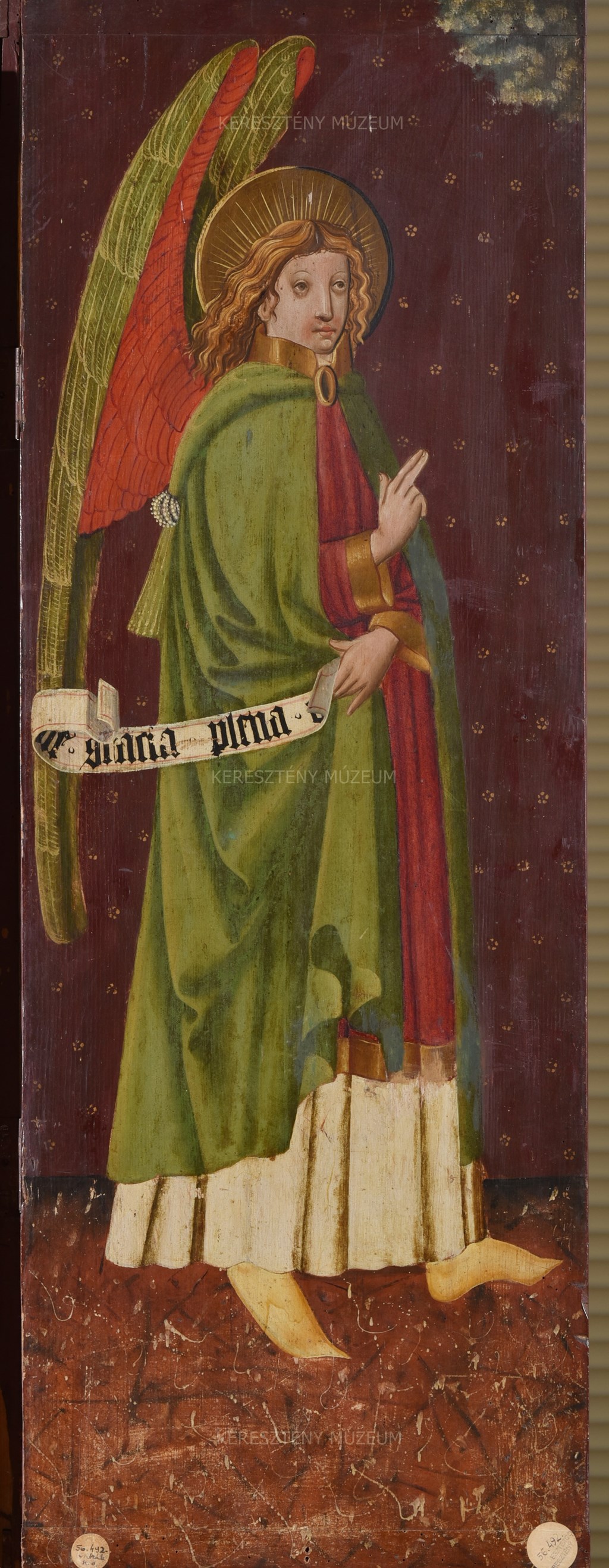
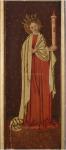
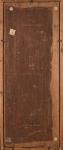
The central image of the altarpiece shows the Dormition of the Virgin Mary, while the inner side of the left wing shows Christ on the Mount of Olives and the Crucifixion, and the outer side displays the archangel Gabriel from the Annunciation. The right wing shows the Crucifixion and the Resurrection of Christ on the inner side, and on the outer Mary from the Annunciation. On the reverse of the central image, various charcoal drawings can be discerned: a head, an article of clothing with many buttons, and a detail of a tower with climbing plants. In Blasius Höfel’s collection it was assembled with a wing depicting St. Catherine of Alexandria, another showing St. Barbara (55.108, 55.109) and a predella with a depiction of the Crucifixion (55.110). The predella could not have belonged originally to the altarpiece, but the two panels showing female saints may have comprised the stationary wings; their corresponding dimensions support this supposition.
Provenance:
Acquired by Karl Lemann from Blasius Höfel in 1839 and then purchased by Arnold Ipolyi. “71. Tryptychon deszkán, közepén Mária halála, szárnyain belül négy jelenet a passióból, kívül az angyali üdvözlet, XIV. sz. vége (?) olasz, igen erősen átfestve.” (Lakatos-Balla-2012 291)/‘71. Triptych affixed to a board. In the middle the Dormition of Mary; on the interior of the wings four scenes from the Passion, on the exterior the Annunciation, end of the 14th c. (?) Italian, substantially overpainted.’/
Restoration:
Dezső Varga, 1958
Bibliography:
Verzeichniss einer Sammlung altdeutscher Gemählde...Wien 1839, 17. sz. – Theodor Frimmel: Lexikon der Wiener Gemäldesammlungen, II. München 1914, 176-177. – Genthon-1932, 28-29. (1400 körül, heiligenkreuzi mester tanítványa) – Pigler Andor: “Evagationes Spiritus” (Egy képmagyarázat és adatok az esztergomi Keresztény Múzeum festményeinek történetéhez). In: Archaeologiai Értesítő 46 (1932-33), 132-134. – Genthon-1948, 126. – Czobor-1955, 13. – Mojzer-1958, 14. – Dávid Katalin: Adatok a Trinitas ikonográfiájához, In: Művészettörténeti Értesítő 11 (1962), 37. Boskovits-Mojzer-Mucsi-1964 154. – Török Gyöngyi: Die Ikonographie des letzten Gebetes Mariä. In: Acta Historiae Artium 19 (1973), 164. – Mucsi-1973, 22. – Mucsi-1975 22. – Mojzer, Miklós: Tabula – Figura – Imago (Három késő középkori lengyel festő működésének rekonstrukciójához). Művészettörténeti Értesítő 26 (1977), 109. – Koller, Manfred: Die technologischen Untersuchungen am Albrechtsaltar und ihre Beiträge zum Problem der „Werkstatt” des Albrechtsmeisters. In: Floridus Röhrig (Hg.): Der Albrechtsaltar und sein Meister, Bécs, 1981, 145-146. (A középkép és a külső Angyali üdvözlet az Albert-oltár megfelelő ábrázolásainak közvetlen másolatai, míg a Passió-jelenetek az aggsbachi oltár képeihez hasonlítanak. Az anyagminták egyezése alapján az esztergomi képeken is a bécsi műhely sablonjait alkalmazták.). – Végh János: Zsigmond király képzőművészeti ábrázolásairól. In: Beke László, Marosi Ernő, Wehli Tünde (szerk.): Művészet Zsigmond király korában Bp. 1987. 110, 34. j. – Cséfalvay-1993, 187. – Eörsi Anna: Puer, abige muscas! Remarks on Renaissance Flyology. In: Acta Historiae Artium 42 (2001), 9-10. – Eörsi Anna: „Elle n’a point eu à subir […] la pourriture, les vers et la poussière…” Remarques sur l’iconographie de la mort de Marie à propos du triptique d’Esztergom réalisé sous l’influence du Maître du Retable du roi Albert. In: Acta Historiae Artium 46 (2005), 5-24. – Eörsi Anna: “Nem korhad el, nem rágják meg a férgek.” Megjegyzések Mária halála ikonográfiájához az Albert-oltár mestere hatása alatt készült esztergomi triptichon kapcsán. In: Művészettörténeti Értesítő 54 (2005),1-18.
Provenance:
Acquired by Karl Lemann from Blasius Höfel in 1839 and then purchased by Arnold Ipolyi. “71. Tryptychon deszkán, közepén Mária halála, szárnyain belül négy jelenet a passióból, kívül az angyali üdvözlet, XIV. sz. vége (?) olasz, igen erősen átfestve.” (Lakatos-Balla-2012 291)/‘71. Triptych affixed to a board. In the middle the Dormition of Mary; on the interior of the wings four scenes from the Passion, on the exterior the Annunciation, end of the 14th c. (?) Italian, substantially overpainted.’/
Restoration:
Dezső Varga, 1958
Bibliography:
Verzeichniss einer Sammlung altdeutscher Gemählde...Wien 1839, 17. sz. – Theodor Frimmel: Lexikon der Wiener Gemäldesammlungen, II. München 1914, 176-177. – Genthon-1932, 28-29. (1400 körül, heiligenkreuzi mester tanítványa) – Pigler Andor: “Evagationes Spiritus” (Egy képmagyarázat és adatok az esztergomi Keresztény Múzeum festményeinek történetéhez). In: Archaeologiai Értesítő 46 (1932-33), 132-134. – Genthon-1948, 126. – Czobor-1955, 13. – Mojzer-1958, 14. – Dávid Katalin: Adatok a Trinitas ikonográfiájához, In: Művészettörténeti Értesítő 11 (1962), 37. Boskovits-Mojzer-Mucsi-1964 154. – Török Gyöngyi: Die Ikonographie des letzten Gebetes Mariä. In: Acta Historiae Artium 19 (1973), 164. – Mucsi-1973, 22. – Mucsi-1975 22. – Mojzer, Miklós: Tabula – Figura – Imago (Három késő középkori lengyel festő működésének rekonstrukciójához). Művészettörténeti Értesítő 26 (1977), 109. – Koller, Manfred: Die technologischen Untersuchungen am Albrechtsaltar und ihre Beiträge zum Problem der „Werkstatt” des Albrechtsmeisters. In: Floridus Röhrig (Hg.): Der Albrechtsaltar und sein Meister, Bécs, 1981, 145-146. (A középkép és a külső Angyali üdvözlet az Albert-oltár megfelelő ábrázolásainak közvetlen másolatai, míg a Passió-jelenetek az aggsbachi oltár képeihez hasonlítanak. Az anyagminták egyezése alapján az esztergomi képeken is a bécsi műhely sablonjait alkalmazták.). – Végh János: Zsigmond király képzőművészeti ábrázolásairól. In: Beke László, Marosi Ernő, Wehli Tünde (szerk.): Művészet Zsigmond király korában Bp. 1987. 110, 34. j. – Cséfalvay-1993, 187. – Eörsi Anna: Puer, abige muscas! Remarks on Renaissance Flyology. In: Acta Historiae Artium 42 (2001), 9-10. – Eörsi Anna: „Elle n’a point eu à subir […] la pourriture, les vers et la poussière…” Remarques sur l’iconographie de la mort de Marie à propos du triptique d’Esztergom réalisé sous l’influence du Maître du Retable du roi Albert. In: Acta Historiae Artium 46 (2005), 5-24. – Eörsi Anna: “Nem korhad el, nem rágják meg a férgek.” Megjegyzések Mária halála ikonográfiájához az Albert-oltár mestere hatása alatt készült esztergomi triptichon kapcsán. In: Művészettörténeti Értesítő 54 (2005),1-18.