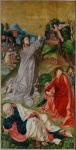
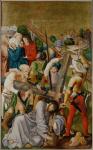
Four panel paintings of the former high altarpiece from Banská Štiavnica (Selmecbánya)
1506
lime wood, painted, gilded
The Crucifixion; detail from the workday side of one of the movable wings
Inv. 55.103
The four paintings originally belonged to the high altarpiece of either the St Catherine's Church, or possibly the Our Lady’s Church in the Old Castle in Banská Štiavnica. The panels decorated the lower register of the former work-day-side. The upper row consisted of the (now lost) Annunciation, the Visitation (preserved in the Hungarian National Gallery), the Nativity (presently in the parish church of Svätý Anton/Hontszentantal) and the Adoration of the Magi (preserved in the Musée des Beaux-Arts in Lille).
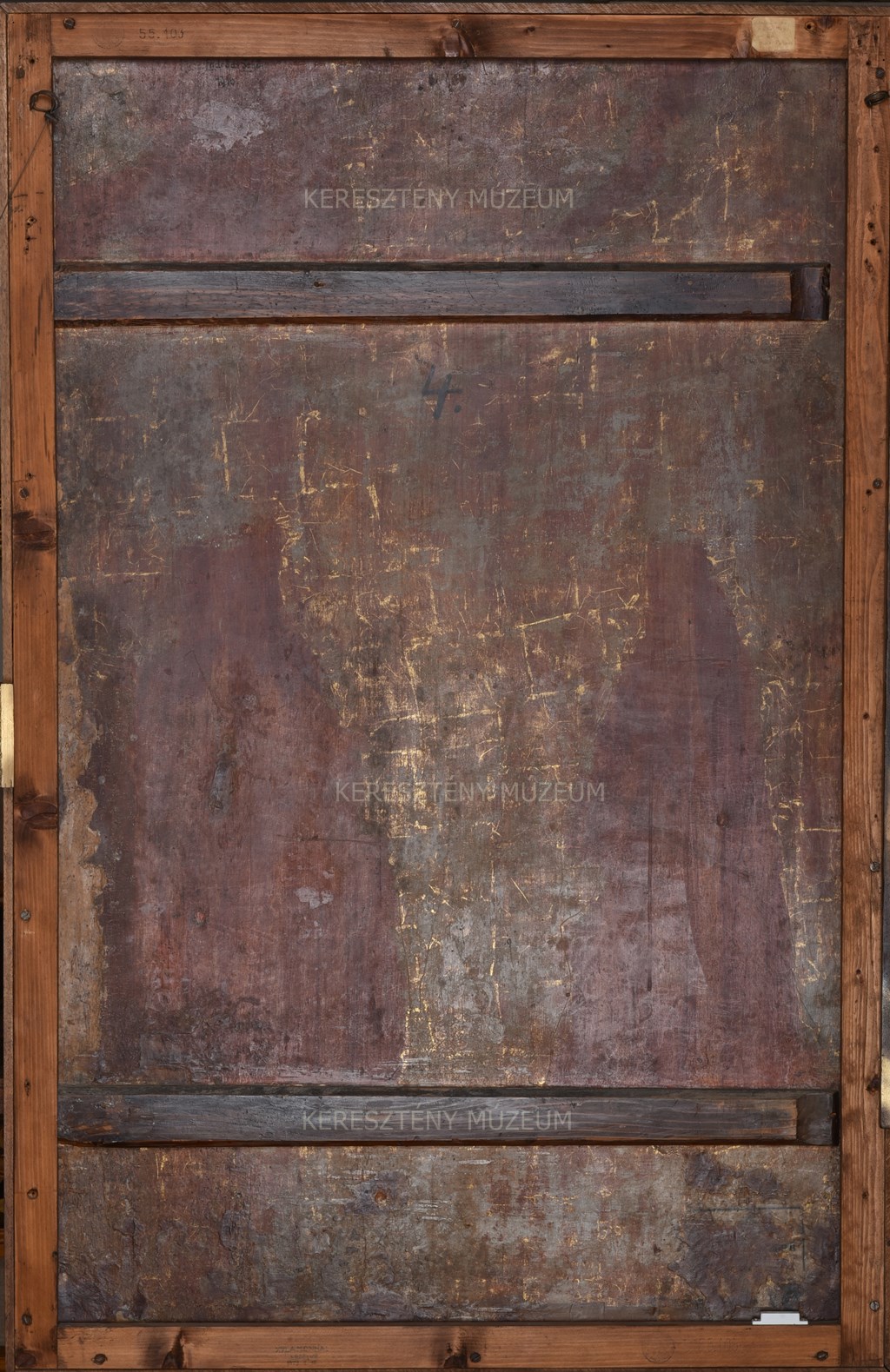
Imprints on the back sides of the Crucifixion and Calvary paintings suggest that the former feast-day-side of the folding wings was decorated with relief compositions, the engraved outlines of which are still visible today, as well as the rests of the gilding that surrounded them. In the upper right-hand corner of the back side of the Resurrection panel, that once belonged to the right hand fixed wing, there is a sketch of probably the beheading of St Catherine.
Recent research has attributed other works (drawings, panels and a mural) to Master MS, and new attributions suggest that the painter spent his early years in Nuremberg, in close proximity to Albrecht Dürer, before settling in Vienna around 1500. The possibility of his identification with Michel Schröter, a painter in Vienna has been raised.
Provenance:
The altarpiece to which Master MS's panel paintings belonged, was documented in the 18th century in the church of St Catherine in Banská Štiavnica. After its dismantling, the paintings were scattered in the surrounding churches. The four passion scenes of the Christian Museum were purchased by János Simor from the property of Prince Koháry-Coburg from Svätý Anton before 1891.
Restoration:
Sebestyén Endrődi, 1915, 1925; Dezső Varga, 1956, 1959, 1968 (cleaning, infills, retouches), Dezső Varga, 1996. 2023 technical examinations of the paintings were executed by Éva Galambos, Mátyás Horváth, Máté Karlik, Zoltán May, Eszter Tuzson
Bibliography (selection):
“Magnificat anima mea Dominum”. MS mester Vizitáció-képe és egykori selmecbányai főoltára. (Edit.: Mikó Árpád, Poszler Györgyi). Magyar Nemzeti Galéria. Budapest 1997 (With complete previous litarature). – Martin Šugár: VPLYV Martina Schongauera na Majstra MS. In: Ars, 2001, 2-3, 127-151. – Martin Šugár: Neskorogotické tabuľové maliarstvo v oblasti stredoslovenských banských miest. In: Pozsony 2003, 475 - 497. – Pozsony 2003, 475, 477, 485, 487, 491, 492, 735, 736, 747, 763, 764. – Mojzer Miklós: A történeti MS mester sive Martinus Swarcz seu Martinus Niger alias Marcin Czarny, Veit Stoss krakkói főoltárának festője (section I. Krakkó, 1485; -and before.) In: Művészettörténeti Értesítő LV. 2006, 223-250. – Mojzer Miklós: II. Teil. Krakau und Nürnberg im Jahr 1477 und davor. In: Annales de la Galerie Nationale Hongroise / A Magyar Nemzeti Galéria Évkönyve XXV. 2005–2007, No 10, 2008, 91 - 140). – Dusan Buran: Pôvodný hlavný oltár Majstra MS. In: Kostol sv. Kataríny v Banskej Štiavnici – klenot neskorej gotiky na Slovensku. Banská Štiavnica, 2017, 91 - 129. – Master MS and his Age (Eds. Gábor Endrődi - Alexandra Kocsis - Manga Pattantyús - Emese Sarkadi Nagy). Ex. Cat. Museum of Fine Arts Budapest 2025.
Imprints on the back sides of the Crucifixion and Calvary paintings suggest that the former feast-day-side of the folding wings was decorated with relief compositions, the engraved outlines of which are still visible today, as well as the rests of the gilding that surrounded them. In the upper right-hand corner of the back side of the Resurrection panel, that once belonged to the right hand fixed wing, there is a sketch of probably the beheading of St Catherine.
Recent research has attributed other works (drawings, panels and a mural) to Master MS, and new attributions suggest that the painter spent his early years in Nuremberg, in close proximity to Albrecht Dürer, before settling in Vienna around 1500. The possibility of his identification with Michel Schröter, a painter in Vienna has been raised.
Provenance:
The altarpiece to which Master MS's panel paintings belonged, was documented in the 18th century in the church of St Catherine in Banská Štiavnica. After its dismantling, the paintings were scattered in the surrounding churches. The four passion scenes of the Christian Museum were purchased by János Simor from the property of Prince Koháry-Coburg from Svätý Anton before 1891.
Restoration:
Sebestyén Endrődi, 1915, 1925; Dezső Varga, 1956, 1959, 1968 (cleaning, infills, retouches), Dezső Varga, 1996. 2023 technical examinations of the paintings were executed by Éva Galambos, Mátyás Horváth, Máté Karlik, Zoltán May, Eszter Tuzson
Bibliography (selection):
“Magnificat anima mea Dominum”. MS mester Vizitáció-képe és egykori selmecbányai főoltára. (Edit.: Mikó Árpád, Poszler Györgyi). Magyar Nemzeti Galéria. Budapest 1997 (With complete previous litarature). – Martin Šugár: VPLYV Martina Schongauera na Majstra MS. In: Ars, 2001, 2-3, 127-151. – Martin Šugár: Neskorogotické tabuľové maliarstvo v oblasti stredoslovenských banských miest. In: Pozsony 2003, 475 - 497. – Pozsony 2003, 475, 477, 485, 487, 491, 492, 735, 736, 747, 763, 764. – Mojzer Miklós: A történeti MS mester sive Martinus Swarcz seu Martinus Niger alias Marcin Czarny, Veit Stoss krakkói főoltárának festője (section I. Krakkó, 1485; -and before.) In: Művészettörténeti Értesítő LV. 2006, 223-250. – Mojzer Miklós: II. Teil. Krakau und Nürnberg im Jahr 1477 und davor. In: Annales de la Galerie Nationale Hongroise / A Magyar Nemzeti Galéria Évkönyve XXV. 2005–2007, No 10, 2008, 91 - 140). – Dusan Buran: Pôvodný hlavný oltár Majstra MS. In: Kostol sv. Kataríny v Banskej Štiavnici – klenot neskorej gotiky na Slovensku. Banská Štiavnica, 2017, 91 - 129. – Master MS and his Age (Eds. Gábor Endrődi - Alexandra Kocsis - Manga Pattantyús - Emese Sarkadi Nagy). Ex. Cat. Museum of Fine Arts Budapest 2025.