


Ildikó Dobrányi (1948–2007)
The Dignity of Tapestry
Memorial Exhibition for Ildikó Dobrányi (1948–2007)
Christian Museum, Esztergom
7 September – 30 October 2008
More about the catalogue...
The artist would have been sixty in 2008. After her death, her admirers formed the Ildikó Dobrányi Memorial Committee. Our purpose is the fullest possible collecting together of works she made individually and with others and their display within the framework of a retrospective exhibition with an accompanying catalogue. Our duty is to hold up her oeuvre and her successes to our contemporaries as well as to posterity, as truth and perfect creative work were characteristic of this artist’s whole life and entire activity. /Maria Anka/
Tapestry has always been a method of creation requiring fastidious design activity and a great amount of physical work, and team work at that. The purpose of works was primarily monarchical display, but also, at least in a given circle, there was intention to ensure an environment of the most distinguished kind. They could have secular or ecclesiastical functions, as in the case of wall paintings (frescoes), which were very often put on walls as copies of woven tapestry. The fresco fragments in the chapel of Esztergom Castle attest to this to the present day. With regard to later posterity also, the monumental gesture that is art patronage is still represented in all those cultures possessing a continuous as opposed to an occasional historical consciousness not only by buildings, sculptures, pictures, and jewellery, but also by the weaving of tapestries. /Miklós Mojzer/
Ildikó Dobrányi was a Gobelin weaver. In a short sketch of her herself in 1997, she declared: ‘As a matter of fact, I do not strive to express an “individual pictorial language”, “a characteristic and individual set of colours”; I merely attempt to convey these details as exactly as possible, with the help of photographs, computer technology, raster definition, etc., and to “foster” these, by means of a traditional slave-work weaving technique known for many centuries.’ This was not just any technique: weaving has long been an example of how an artistic technique can become the creator of a world. The wonder of weaving is that with a few materials, principally coloured wool, it is capable of evoking a world from a covering, of presenting the diversity of nature from threads woven together with one another. For Ildikó Dobrányi, detail came from this, detail which is from a whole and from which we get to know the whole. In this she was a modern artist. Others have sought fullness in individualism, in the filling out of an individual way of seeing; she, for her part, adhered to the traditional Gobelin technique. /Ernő Marosi/
 | |
A fact, however, is the outstanding professionalism of her weaving technique, probably for the most part due to her studies in Aubusson and in Paris. Looked at from this point of view, her tapestries may serve as a model for every tapestry weaver and reveal certain characteristics of her personality such as lucidity and sincerity. /Peter Horn/
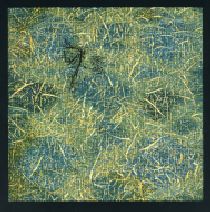
The synthesis and conclusion of the ‘Grass’ series of tapestries was the large, celebratory, red ‘Nomadic Rug’ that was made in 1996. Through the millefleurs mobility of its background and the small green horse alone in the middle, this recalls the tapestries featuring unicorns. However, in her next works – ‘Forever’ and ‘Alternative Renaissance’ – her attention again turns to the crowns of trees, towards the sky, as a kind of frame for the conclusion of her oeuvre.
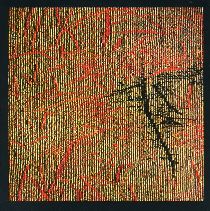
These three large-scale tapestries are framed by a characteristic wide border. In Ildikó Dobrányi’s art a return to traditions and a link to the classic tradition are present not just in her use of technique and in her choice of theme, but in the renewal, too, of an element such as the border, which in contemporary tapestry is generally omitted. Around the grassy expanse of the work ‘Nomadic Rug’ runs a very fine grass frame. The asymmetrical semi-border of her ‘raster strip’ tapestry entitled ‘Forever’ depicting vegetation and recalling the earlier works also reflects these historical models. The work of her last creation, entitled ‘Alternative Renaissance’ and woven in 2004, depicts dying vegetation – perhaps as an intimation of her approaching end – and is bordered by a serious, thick border. /Ibolya Hegyi/
 | |
Over a ten-year period, membership of the Association reached approximately 100. It was first and foremost professional tapestry artists who were taken into its ranks, those who were able to guarantee the high standard of the profession in the long term. However, based on assessment of individual cases, artists active in other fields could also gain admission, and so, too, could weavers.
Ildikó Dobrányi’s efforts as President can be discerned in three directions. She considered the ensuring of a continuous presence for Hungarian tapestry both at home and internationally to be her primary task. Secondly, she wished to create homes for the genre, by founding a workshop that was its own and by operating a venue for exhibitions. Last, but not least, she placed emphasis on the scholarly study of the genre and on publications. /Ildikó Kontsek/
Following my joining, I received an invitation to participate in collective works organised by the Association. In 2000, the ‘St. Stephen Tapestry’ was completed to an order placed by the Christian Museum in Esztergom. In the summer of 2006, the second collective work, the ‘Corvinus Tapestry’, was finished for the National Commemorative Site at the National Széchényi Library in Budapest.
These projects were special experiences for me, because although I was a member of a number of international organisations, collective work of this kind – where artists worked in shared rooms in a shared studio (the Budavár Tapestry Workshop) – I had never before taken part in. In fact, I had never even heard of an initiative of this type. /Marika Száraz/
 | |
I had never seen an exhibition of tapestry art quite like ‘KÁRPIT 2’. The works chosen were presented in an overwhelmingly sophisticated way – I could not imagine even one of the works being allowed to hang in a different place. The contemporary tapestries were accompanied by historic tapestries from France, as well as historical objets d’art from Hungarian museum collections. /Peter Horn/
Hers was a generous personality, and her ideas, too, were on a big scale. She set as her goal nothing less than the setting sail of Hungarian tapestry art, which looks back on a great tradition and is professionally accomplished albeit historically marginalised, on international seas. She sensed a fitting historical moment, in national and international connection alike, and took direction into her own hands. She kept her hands on the wheel until the very last moment. She knew full well that without her the ship would become a phantom ship, prey to petty, personal interests, which would of course lead it astray into uncharted waters. She was a visionary figure and she saw this clearly. Like the captain of a real ship, she was a rock-solid character, hard and unyielding: compromise was unknown to her in her thinking. All those even remotely touched by her in any phase of her ambitions plans, all those with whom she came into contact, she swept off their feet with the charm of her personality and her penetrating sense of purpose. The movement which she created, the phenomenon which is hallmarked by her name, the exhibitions, the catalogues, and the successes achieved internationally, all rest on these foundation stones: on her clearness of vision, on her personal management of affairs, on her timely reactions, and on her complete lack of opportunism. /Edit András/